

Nobody ever abandoned Tintin on page three.
That alone should make you suspicious. Learners abandon textbooks, graded readers, and "easy" novels constantly — usually somewhere between the third unknown word of a paragraph and the tenth. Yet somehow, people who claim they "can't read in a foreign language yet" will happily finish an entire album of Astérix.
This is not an accident. Comics are quietly one of the best vocabulary tools ever invented, and the reasons are worth understanding — because they tell you a lot about how words actually stick.
Every panel is a built-in dictionary
The core problem of reading in a foreign language is that unknown words arrive naked. A novel gives you "Il saisit la gaffe" and you're off to the dictionary — or, more likely, off to your phone and gone forever.
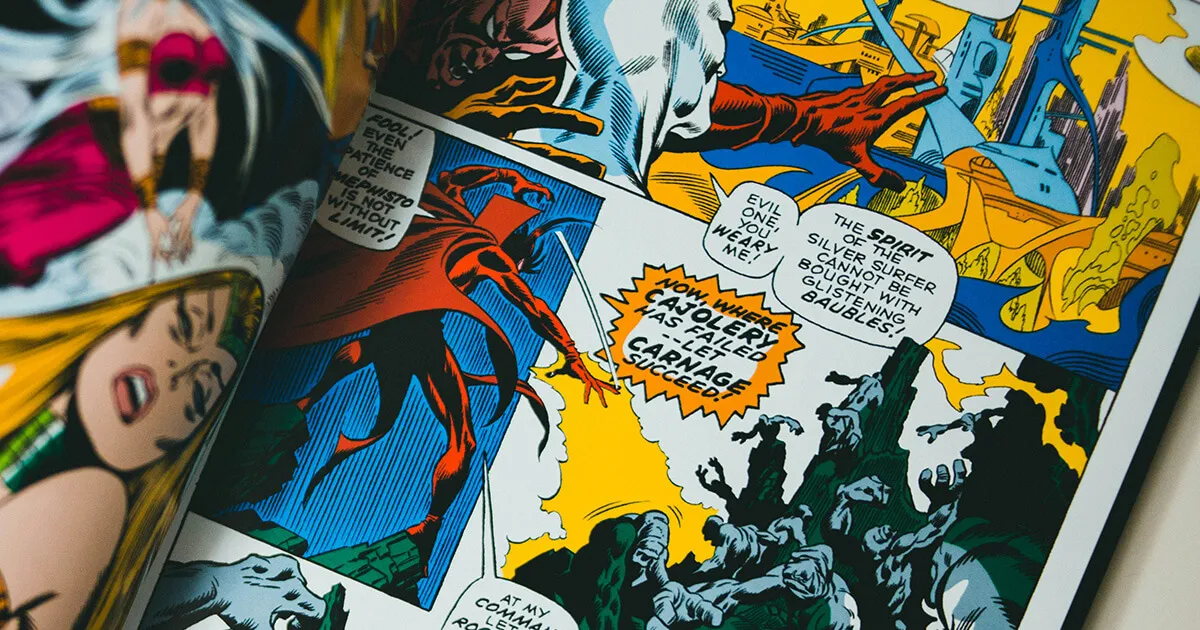
A comic gives you the same sentence under a drawing of a man grabbing a boat hook. The picture does what a dictionary does, but instantly, and without breaking your flow. Linguists call this comprehensible input: language just slightly above your level, made understandable by context. Comics manufacture that context on every single panel.
And because words learned in context stick far better than words learned as bare translations, that picture isn't just a convenience — it's the memory hook itself.
Comics speak the language people actually speak
Here's the dirty secret of most reading material: novels are written in narrator-language. Beautiful, literary, and almost useless for your next conversation.
Comics are ninety percent dialogue. Greetings, arguments, complaints, jokes, threats, apologies — the entire social register that textbooks compress into one sterile chapter called "Conversations." When Captain Haddock erupts into insults, you're getting spoken French with its exclamations and rhythms intact. That's the register you need at a dinner table, and almost nowhere else in print do you get it.
Low text density is a feature, not a weakness
A page of a novel might carry 300 words; a comic page carries 30. Wrong conclusion: comics teach less. Right conclusion: comics let you finish.
Finishing matters more than people admit. Every completed album is proof to your own brain that you can read in this language — and motivation, not method, is what usually collapses first. Thirty words a page, fully understood with pictures attached, beats three hundred words abandoned in frustration.
The comics are also the culture
This is the part most learning guides skip: in many countries, comics aren't children's entertainment — they're national institutions, and knowing them is itself cultural fluency.
- French: the Franco-Belgian bande dessinée is officially "the ninth art" — France gives comics the museum-and-festival treatment other countries reserve for cinema. Tintin is the learner's ideal: clean, neutral French in unmistakable situations. Astérix is the graduate course — its puns are legendary, and every album doubles as a tour of French cultural self-irony.
- German: Mosaik, born in the GDR and still running, is Germany's longest-lived comic — reading it touches a piece of East German history most learners never meet. Werner delivers the colloquial northern German that no textbook will admit exists.
- Spanish: Quino's Mafalda — a six-year-old Argentine girl asking why the world is broken — is Latin America's most beloved export, quoted by presidents. Spain answers with Mortadelo y Filemón, pure slapstick packed with everyday idiom.
- Italian: Italy is the country where Disney comics became Italian literature — Topolino has its own canon, its own authors, and impeccable everyday Italian. For adult register, Dylan Dog has taught two generations how Italians actually talk.
- Portuguese: Turma da Mônica isn't a comic in Brazil; it's a childhood. Mauricio de Sousa's characters are national icons, and the strips carry warm, everyday Brazilian Portuguese in miniature doses.
- English: Calvin and Hobbes is the great vocabulary smuggler — a six-year-old wielding words like perfunctory and soporific — while Peanuts proves how much depth plain English can carry.
We'll go deeper into each of these — the language quirks, the cultural background, the right reading order — in a series of follow-up guides.
How to turn panels into permanent vocabulary
Reading alone builds recognition; it doesn't build recall. You'll understand la gaffe the next time Tintin grabs one, but that's not the same as producing the word when you need it. Recognition and recall are two different muscles.
The fix is the same as with books, podcasts or Netflix: capture the words that matter while you read, with their context — not as naked translations — and let spaced repetition do the retention work. With Vokabulo that's a few seconds per word: save it, the AI wraps it in a natural example sentence, and it shows up in your daily session right before you'd forget it. The comic already gave the word a face; the app makes sure it keeps it.
Frequently Asked Questions
Are comics actually good for learning a language? Yes — research on comprehensible input shows that pictures anchor unfamiliar words to meaning, and comics deliver almost entirely dialogue, which is exactly the register you need for real conversations. Low text density also keeps frustration down at lower levels.
Which comics are best for learning French? Start with Tintin — clean, neutral French with crystal-clear situations. Graduate to Astérix once you're intermediate: its puns and cultural references are a masterclass, but they assume solid basics.
Aren't comics too childish for adult learners? The format is simple; the language often isn't. Mafalda is political satire, Dylan Dog is written for adults, and Calvin and Hobbes uses vocabulary that sends native speakers to the dictionary. Comics are a medium, not a reading level.
How do I keep the words I learn from comics? Capture them as you read — with context, not as bare translations — and review them with spaced repetition. A word learned from a comic panel already has an image attached, which makes it dramatically easier to retain.
Grab an album, grab your phone. Save the words that make you smile — Vokabulo turns them into vocabulary that stays. Free to start.