

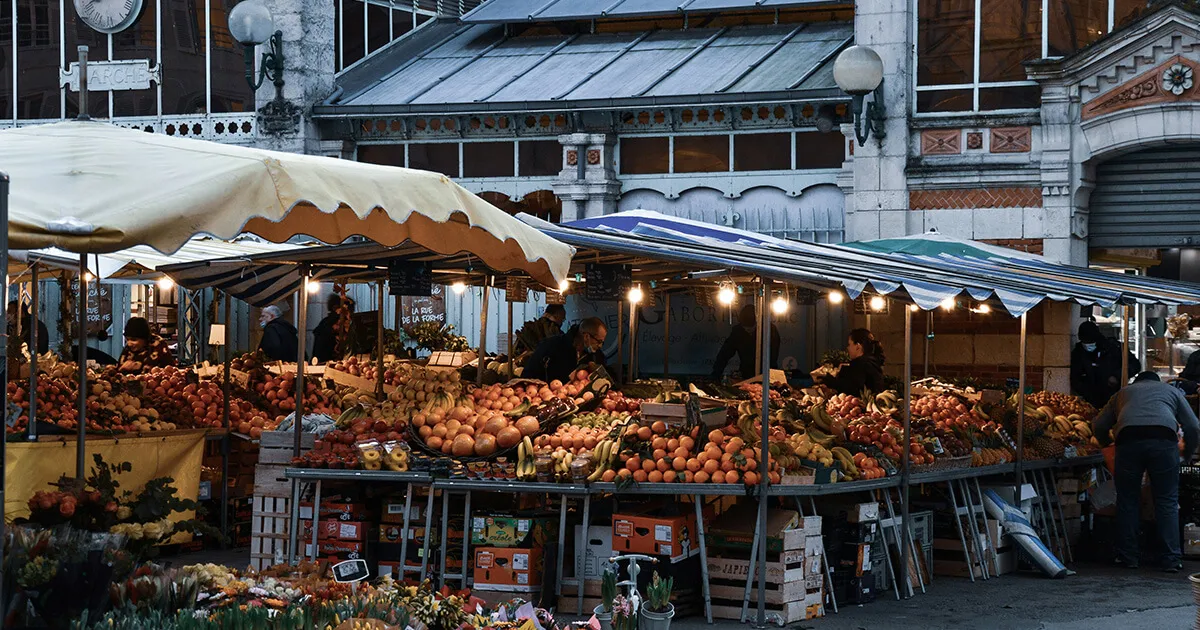
The marché is one of the great institutions of French life. Every town and most city neighbourhoods have at least one per week; in larger cities, daily markets are common. The marché is where you buy the best produce, the best cheese, and the best charcuterie — and where a five-minute conversation with a maraîcher (market gardener) teaches you more practical French than a week of lessons.
The vocabulary is specific, informal, and fast-paced. Here is what you hear and what you say.
Stalls and Stallholders
Marché — market. Marché couvert (covered market, often permanent), marché de plein air (outdoor market).
Maraîcher / Maraîchère — a market gardener / vegetable stall holder. The person selling fruit and vegetables they've often grown themselves.
Fromager / Fromagère — a cheesemonger.
Charcutier / Charcutière — a cured meats seller (saucisson, pâté, jambon, etc.).
Boulanger / Boulangère — a baker (bread stalls at markets often come directly from the local bakery).
Poissonnier / Poissonnière — a fishmonger.
Boucher / Bouchère — a butcher.
Volaille — poultry. A volailler sells chicken, duck, guinea fowl, etc.
Primeur — early-season / fresh produce; also the term for a market stall selling fruits and vegetables.
The Exchange
C'est à qui? — Whose turn is it? (Whose next?) This is how the stallholder signals they're ready for the next customer.
C'est à moi. — It's my turn.
Qu'est-ce qu'il vous faut? — What do you need? (What are you after?)
Je voudrais... — I would like...
Donnez-moi... — Give me... (direct but perfectly polite at a market)
Il me faudrait... — I need... (slightly softer)
Je cherche... — I'm looking for...
C'est tout? — Is that all?
Avec ceci? — Anything else? (Literally: with this?)
Et avec ça? — Same; "And with that?"
C'est pour combien de personnes? — How many people is this for? (Asked when buying cheese, fish, or meat where the seller may cut to size.)
Quantities
Un kilo de — a kilo of...
Une livre de — half a kilo of (a livre is 500g in French market usage).
Deux cents grammes de — 200 grams of...
Une barquette de — a punnet of (strawberries, tomatoes, etc.)
Un bouquet de — a bunch of (radishes, parsley, etc.)
Une botte de — a bundle of (leeks, asparagus, etc.)
Juste un peu — just a little.
Un peu plus — a little more.
Un peu moins — a little less.
Comme ça? — Like that? (The seller is checking the portion size before cutting.)
C'est bien comme ça. — That's fine like that.
Pouvez-vous en mettre un peu moins? — Could you put a little less?
Produce
Légumes — vegetables.
Fruits — fruit.
Herbes aromatiques — fresh herbs. "Vous avez du basilic / du thym / du romarin?" — Do you have basil / thyme / rosemary?
Salade — lettuce / salad leaves.
Poireaux — leeks.
Courgettes — courgettes.
Aubergines — aubergines.
Champignons — mushrooms.
Tomates — tomatoes.
Fraises — strawberries.
Cerises — cherries.
Pêches — peaches.
De saison — in season. "C'est de saison?" — Is it in season? "Qu'est-ce qui est bon en ce moment?" — What's good right now?
Bio — organic.
Local / du coin — local / from around here.
C'est de chez vous? — Is this from your farm / did you grow this?
Produit fermier — farm produce.
Cheese and Charcuterie
"Je voudrais un morceau de ce fromage, s'il vous plaît." — I'd like a piece of this cheese, please.
"Quel est ce fromage-là?" — What's that cheese there?
"Il est fort ou doux?" — Is it strong or mild?
"Fait maison" — home-made / made on the premises. A good sign at a charcuterie.
"Un peu affiné, un peu moins affiné?" — More mature, less mature? (The fromager is asking your preference for ripeness.)
"Il est à point." — It's perfectly ripe / ready.
Tranchée — sliced. "Tranché, s'il vous plaît." — Sliced, please.
Entier — whole.
En bloc — as a whole piece (rather than sliced).
Payment
C'est combien? — How much is it?
Combien je vous dois? — How much do I owe you?
Je n'ai pas de monnaie. — I don't have change.
Vous acceptez la carte? — Do you accept card? (Many small market stalls are cash-only; carry cash.)
The marché is the fastest and most enjoyable classroom for practical French. The vocabulary above is the vocabulary of becoming a regular — the kind of customer the fromager recognises and treats well.
Market French is practical French at its best. Vokabulo helps you build the vocabulary for the stalls you actually visit every week. Available on iPhone and iPad.