
Ask a French person about comics and you'll hear about the ninth art. Ask a German and you'll get a pause — then, if they grew up in the East, their eyes will light up: Mosaik.
Germany's homegrown comic culture is smaller than France's, but what it has is remarkable — and for learners, it's an untouched goldmine, because no textbook ever mentions it.
Mosaik: the comic that outlived its country
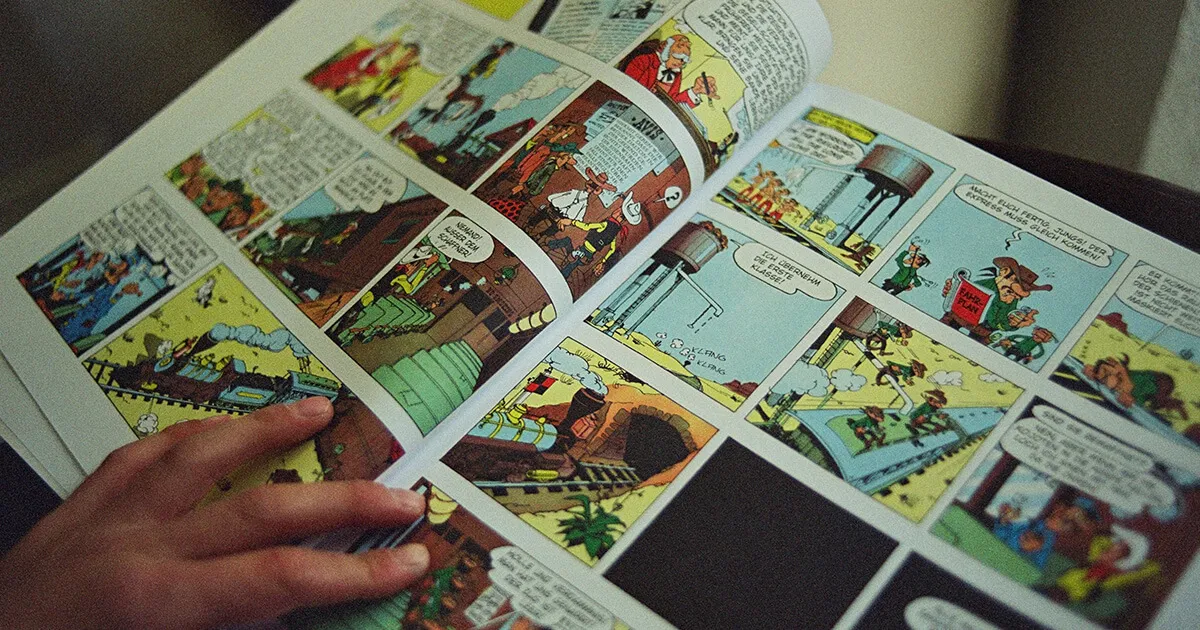
Founded in 1955 in East Berlin, Mosaik is Germany's longest-running comic — and its history is a history lesson in itself. Created under GDR cultural policy (adventure stories were acceptable; American superheroes were not), its original hero trio, the Digedags, traveled through Rome, the Orient, and the American frontier as a kind of state-approved escapism. Their successors, the Abrafaxes — Abrax, Brabax, and Califax — have been time-traveling since 1976 and never stopped: through the fall of the Wall, reunification, and into present-day kiosks.
Reading Mosaik touches something most German-as-a-foreign-language learners never encounter: East German cultural memory. For millions of Ossis, the Digedags are what Tintin is to a Belgian — childhood itself. Mention Mosaik to a colleague from Leipzig or Dresden and watch the conversation change.
The German itself is a learner's dream at B1+: standard, carefully edited Hochdeutsch, adventure-plot vocabulary, and historical settings that recycle the same word fields (ships, courts, markets, journeys) album after album — built-in spaced repetition, before the app gets involved.
Werner: how the North actually talks
If Mosaik is the schoolbook-safe classic, Werner is the opposite: Rötger Feldmann's beer-loving, moped-riding plumber's apprentice from Schleswig-Holstein became an eighties-and-nineties phenomenon — million-selling albums, feature films, and a permanent place in German pop culture.
Werner's value for learners is exactly what makes teachers nervous: it's written in genuine northern colloquial German. Contractions textbooks deny (haste for hast du, kannste for kannst du), workshop banter, Moin, and the art of the laconic North German reply. This is the register you hear in a Hamburg Kneipe and search for in vain in any course book — the printed cousin of the regional German no language school covers.
Fair warning: Werner is B2+ material. The spelling bends to the sound of speech, and the humor assumes you know how ordinary German sounds first. That's not a flaw — it's the point. When Werner starts being funny, your German has arrived somewhere real.
The cultural background deepens the joke: Werner is inseparable from German Handwerker culture — apprenticeships, workshop hierarchies, the sacred Feierabendbier. It's a comic about the Germany that builds things, in the language that Germany actually speaks. Textbook German gets you through the meeting; Werner's register gets you through what modal particles hint at — the emotional soundtrack of casual German.
The bridge option: the classics in German
If B1 feels far away, start where German children start: Tim und Struppi (Tintin) and Astérix in German translation. The translations are superb — Astérix's German translator Gudrun Penndorf is celebrated in her own right — and give you picture-anchored standard German from A2. Then graduate east to Mosaik, and north to Werner.
Keep the words, not just the memory
Whichever you read, the workflow is the same as for any comic: the panel gives each word a face; saving it with context makes it permanent. Capture Feierabend from a Werner panel into Vokabulo and the AI wraps it in a natural sentence — then spaced repetition returns it right before you'd forget. Twenty words per album, kept forever, beats two hundred read and lost.
Found a word that made you grin — haste, Moin, Feierabend? Save it to Vokabulo with its context and keep it. Free to start.