Vokabulo

Press & Media

Vokabulo was built for people who live every day in another language.

Language apps and courses teach the foundations: grammar, pronunciation and the first thousand words. But around B1, the problem changes. Now the challenge is finding the words to say exactly what you mean. After B1, your vocabulary becomes personal. Vokabulo helps you build the words that belong to your life alone.

Key facts

Product
Vokabulo
App Store name
Vokabulo: Vocabulary Trainer
In one sentence
An AI vocabulary trainer for everyday life in another language: for the words that come from work, conversations and interests
Category
Education, language learning, vocabulary
Positioning
Not for starting a language. For moving from B1 to C2
Audience
Learners from B1 upward who already use a second language at work, at home or in daily life
Platform
iPhone and iPad (requires iOS 26 or iPadOS 26). No Android version
Languages
More than 100, in any combination
Interface languages
English, German, French, Italian, Spanish, Portuguese
Price
Free with limits. Vokabulo Pro is $69.99 a year in the US, £59.99 in the UK and €69.99 in the eurozone, about €5.83 a month. Pro Family covers up to six people for $99.99, £99.99 or €119.99 a year. Apple sets prices per storefront, so they differ by country
What Pro adds
More than one language pair, unlimited translations and Scenes, the AI tutor beyond the first 30 days, and import of the learner’s own word lists with context enhancement
First released
23 March 2026
Publisher
Tathros GmbH, Bad Soden am Taunus, near Frankfurt am Main, Germany
Developer
Wolfgang Männel
Availability
Apple App Store
Press contact
Wolfgang Männel, press@vokabulo.com
Current version
26.09.04, released 14 September 2026
App Store rating
5.0 from 42 ratings (worldwide)

Story angles

Six stories run through Vokabulo. Each one stands on its own and can be reported without the others.

  1. 01 After B1, vocabulary becomes personal
  2. 02 Knowing what a word means is not knowing how to use it
  3. 03 Tone is the last thing a learner acquires and the first thing others notice
  4. 04 Nobody builds the vocabulary of one particular life
  5. 05 Why learn a language when AI translates instantly?
  6. 06 One proficiency level cannot describe one person

01

After B1, vocabulary becomes personal

Grammar is finite: a fixed amount, learned once, then behind you. Pronunciation is practice. Vocabulary is the only part of a language that never ends, and the only part that belongs to one person rather than to everyone.

Take two Germans learning French. One is twenty-three and studying in Lyon: she needs coloc, partiels, rendre un devoir. The other is fifty-five and sits in meetings in Paris: he needs levée de fonds, conseil d’administration, à titre indicatif. As beginners they needed the same words. They never will again.

The shift can be counted, and the arithmetic is the whole argument.

The first thousand words belong to everyone. The next five thousand belong to one person.

That is why beginner courses work so well, why nobody can write the next five thousand down in advance, and why the market is crowded below B1 and nearly empty above it.

Vokabulo therefore has no syllabus. There is no lesson one and no unit two, because at this stage there is nothing left to sequence. The app opens on the learner’s own list, and it holds only what that learner has met or is about to meet.

02

Knowing what a word means is not knowing how to use it

Look a word up and you get what it means, which is the least useful thing about it. What a learner still does not have is the sentence it lives in.

Take run. You run a company, you run out of time, the paint runs, you run for office. Four unrelated meanings, one entry, and no dictionary line that can hold all four at once. A translation pair is not slightly incomplete here; it is structurally incapable of carrying the information. The same is true of the word a particular learner needs; they have simply not met the other meanings yet.

That is why a word saved on its own is a word they will recognise a month later and still not be able to use. Recognising a word and producing it are two different abilities, and only the second one shows up in a conversation.

Nobody ever learned a word on its own. People learn sentences, and keep the words that were in them.

In Vokabulo every word therefore arrives inside a sentence the learner would actually say, in their own situation and at their own proficiency, rather than as a pair of entries.

03

Tone is the last thing a learner acquires and the first thing others notice

Grammar mistakes are forgiven instantly. Everyone can hear that the speaker is working in a second language, and nobody minds. The mistakes that cost something are the correct ones.

Someone learning German who knows that voll means full finishes dinner, says ich bin voll, and has just told the table they are drunk. Someone learning French who picked up bosser from colleagues and puts it in a job application has made no grammatical error at all. The word was right. The dictionary was right. Nothing warned them.

Mistakes of this kind are not read as language errors but as character: too casual sounds disrespectful, too formal sounds cold, and in neither case does anyone explain what happened. This layer is almost never taught. Native speakers absorb it without noticing it exists, dictionaries rarely mark it, and a translation gives no clue at all. It is the last thing a learner acquires and the first thing other people notice.

A grammar mistake is forgiven in a second. It is the perfectly correct sentence in the wrong tone that people remember.

Vokabulo therefore carries a usage note with the word into every review. The aim is not to know what a word means, but to know when it can be used.

04

Nobody builds the vocabulary of one particular life

Three kinds of help exist, and all three are good at what they do. Courses and beginner apps teach the language. Podcasts, books and television put a learner in front of it. Flashcard apps help them remember whatever they have already decided to learn.

Between the three sits a request none of them answers: I can already speak this language, now help me speak it well. It has stayed unanswered because it cannot be packaged. The words are different for every person, they mean nothing outside a sentence, and meeting a word once is not the same as reaching for it a month later.

Every kind of language help stops where a person’s own words begin. That is the part nobody had built.

Vokabulo deliberately does not try to be any of the three. It does not teach the language, it does not supply the reading, and it does not hand out somebody else’s deck. It does the connecting work none of them do: catch the word, keep what was around it, and bring it back until it is there without thinking.

05

Why learn a language when AI translates instantly?

The honest answer to why anyone should still learn a language is that translating and speaking are different acts. A machine translation is correct and belongs to nobody. Being addressed in your own language, even imperfectly, carries an effort that is most of the message, and no device on the table performs it for the speaker.

There is a practical half as well. AI has made translation instant and free, and it has made nobody more articulate. A learner who leans on it in the moment still cannot produce the word the next time, because nothing was retained.

Translation is free now. Being understood as yourself never was.

Vokabulo takes the position that AI earns its place at one point in particular: after B1, where the vocabulary a person needs is too specific for anyone to have written it down in advance. The AI does the work no human could do at a learner’s elbow, writing an example sentence for their word, generating the vocabulary of a situation they name, matching both to their proficiency. It never has the conversation for them, because the conversation was the point.

06

One proficiency level cannot describe one person

The same person, on the same day, can chair a budget meeting in their second language without hesitating and then follow perhaps half of a parents’ evening at their child’s school. Neither of those is their level. Both are.

What separates them is coverage, not competence. Years of work have supplied every word a budget meeting needs. Nothing in that person’s life has ever supplied the vocabulary of a school report, a reading group, or a teacher’s careful way of raising a concern. A single proficiency score averages the two and describes neither.

This also explains why the gaps that hurt most are the rare ones. A diagnosis, a rental contract, a conversation with a lawyer: the situations that demand the most precision are the ones a person meets least often, so ordinary exposure never fills them in. Someone can live in a country for a decade and meet the vocabulary of a hospital on the day it counts.

The same person can chair a meeting in a second language at noon and lose the thread at a parents’ evening at six. Both of those are their level.

Vokabulo therefore works from the situation rather than from the score. The learner describes what they are walking into and gets the vocabulary it demands, matched to their proficiency, before rather than after.

The story in four lengths

One sentence

Vokabulo is a personal vocabulary trainer for people working from B1 toward C2, built on the words each learner’s own work, conversations and interests require rather than on a shared syllabus.

One paragraph

Most language apps and courses are built for the road to B1: the grammar, the pronunciation and the first thousand words everybody needs. Vokabulo is a personal vocabulary trainer for what comes after. Once a learner can already speak, the words they still lack come from their own work, conversations and interests, so there is no shared list left for a course to teach. Vokabulo lets them capture any word they meet, fills in the translation, a natural example sentence and a usage label, and brings it back at the moment they would otherwise lose it, until they can reach for it under pressure. They can also describe a situation they are about to face, a rental contract appointment or a client presentation, and get the vocabulary for it in under a minute. What changes is not how many words they have remembered. It is whether they can say exactly what they mean, sound natural doing it, and stop reaching for the same safe words. Vokabulo supports more than 100 languages in any pair combination, runs on iPhone and iPad, and is free to start.

Full description

The problem. Millions of people can hold a conversation in a second language, get through a meeting in it and read without a dictionary, and still sound simpler than they are. Grammar has stopped being the obstacle. What is missing is vocabulary, and past B1 the vocabulary a person needs depends on their profession, their relationships and whatever they happen to read, so there is no shared list left for a course to teach. Vokabulo therefore has no syllabus. It has a method for building one.

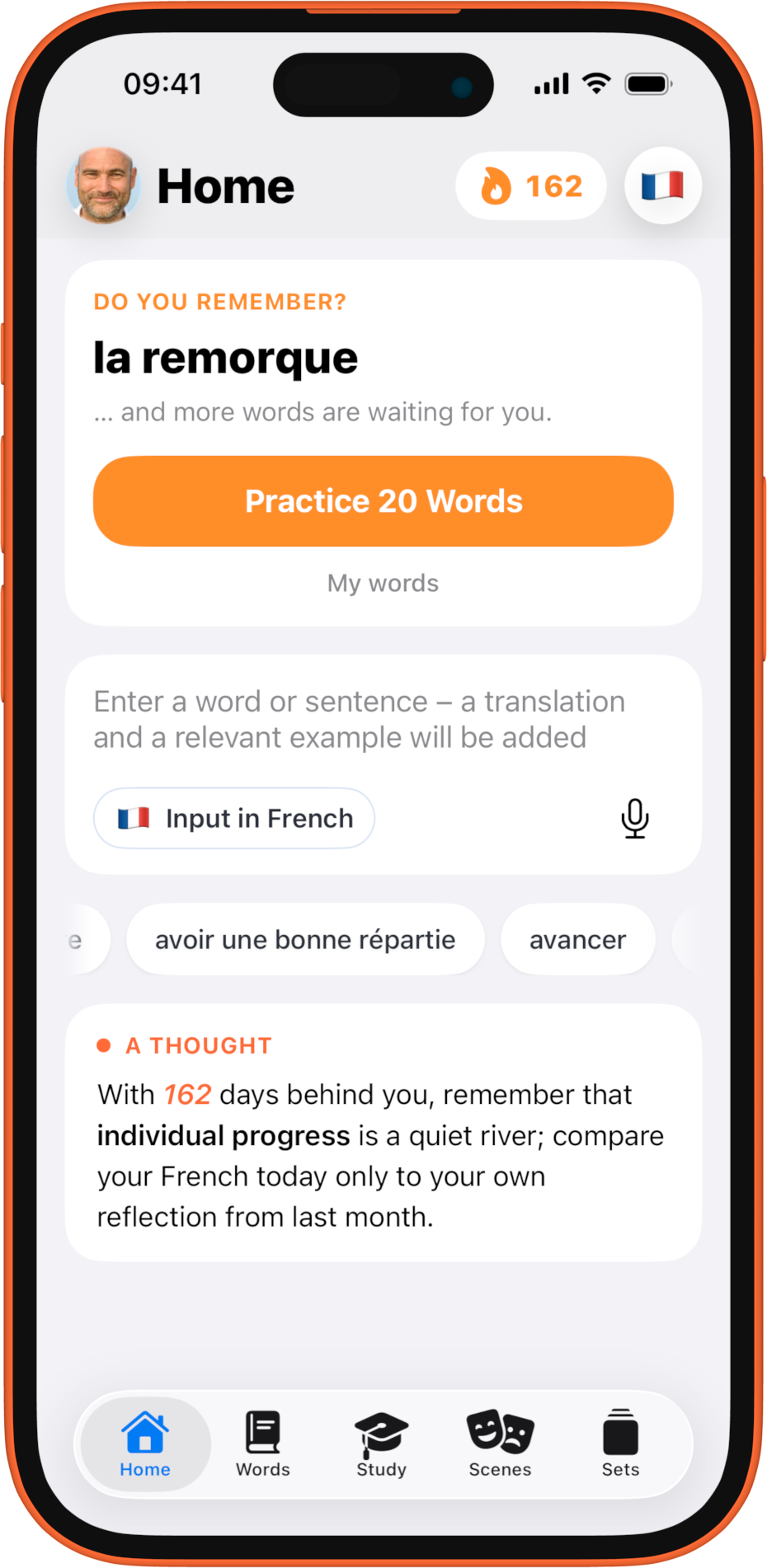
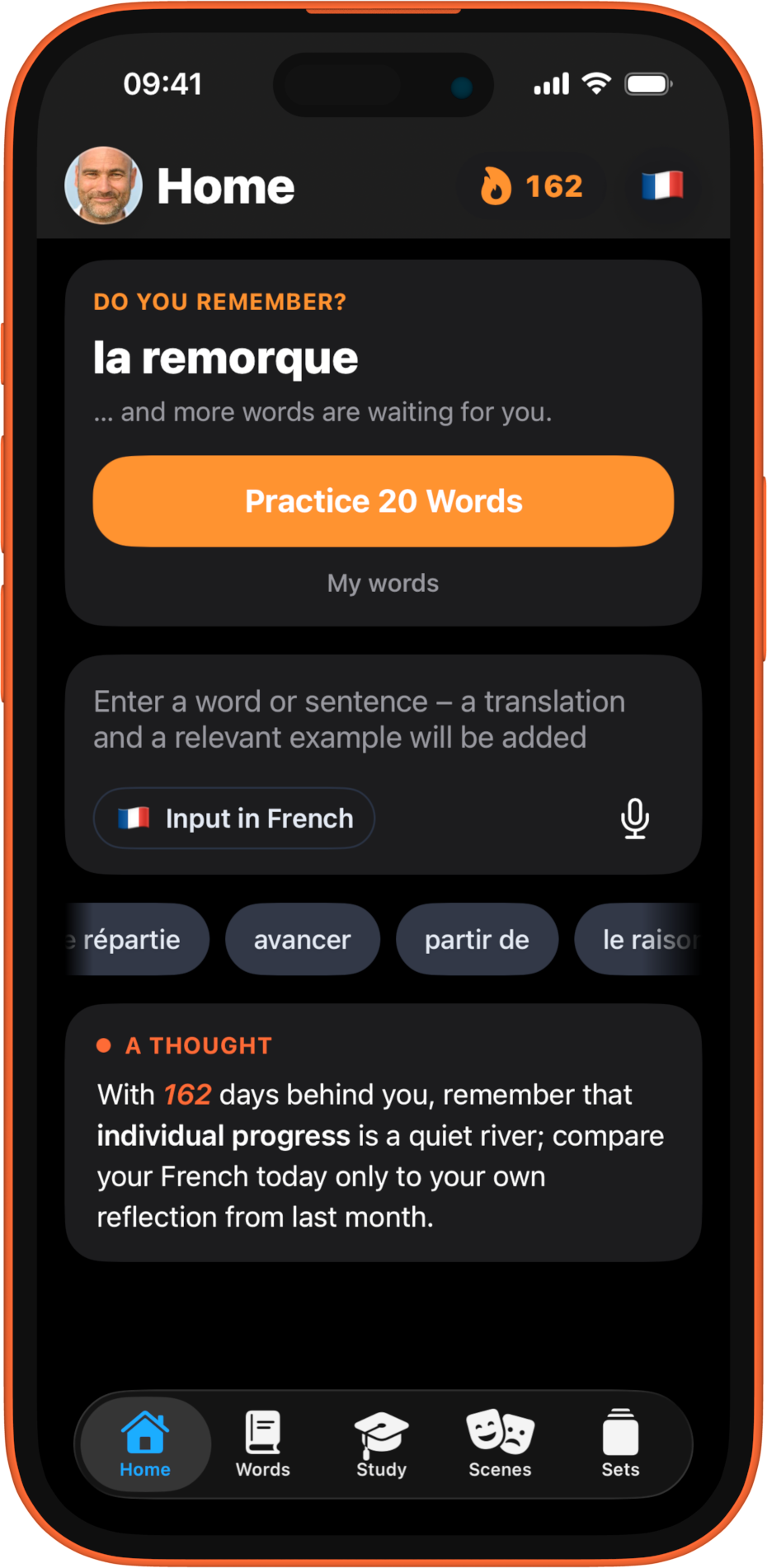
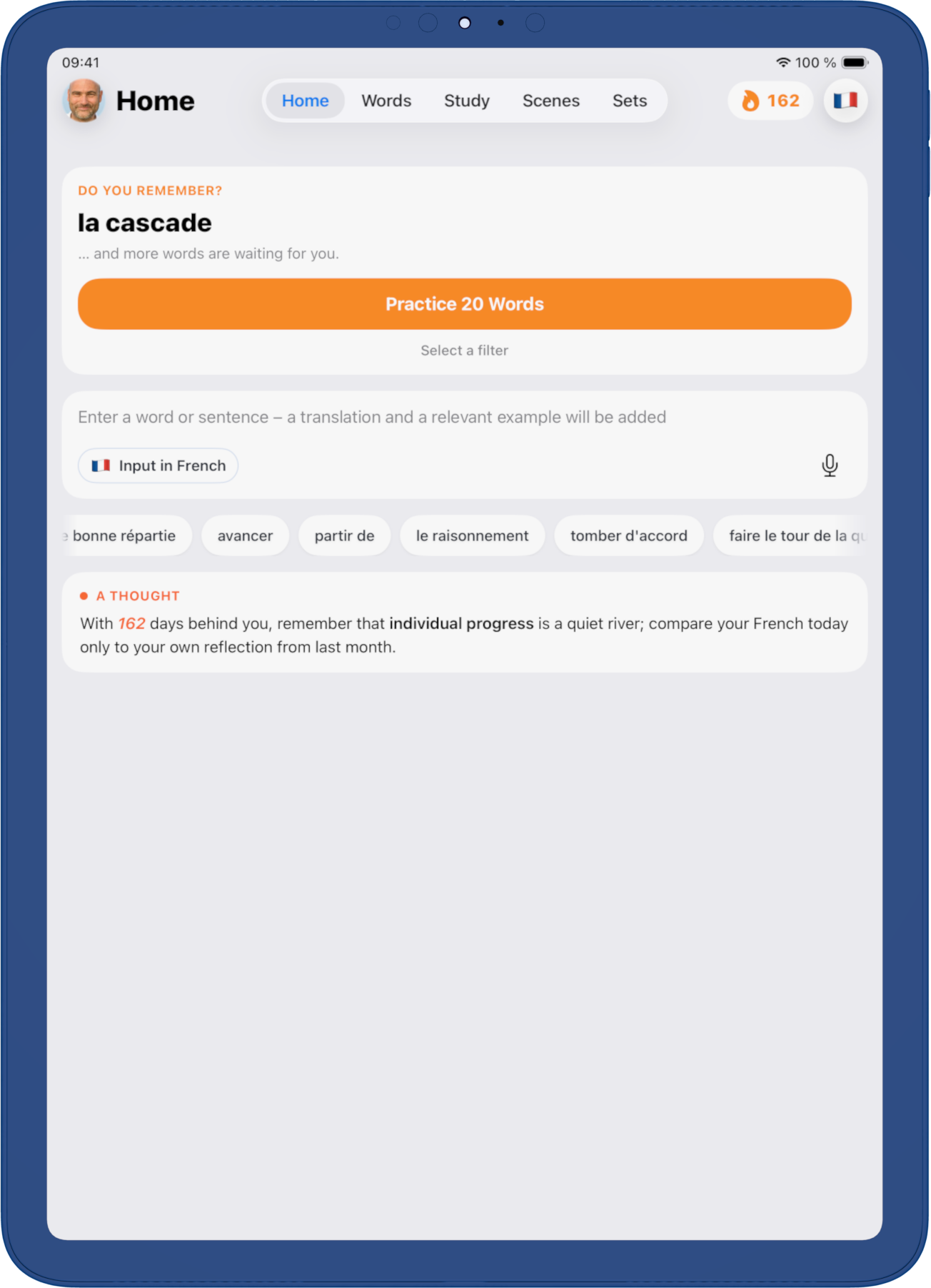
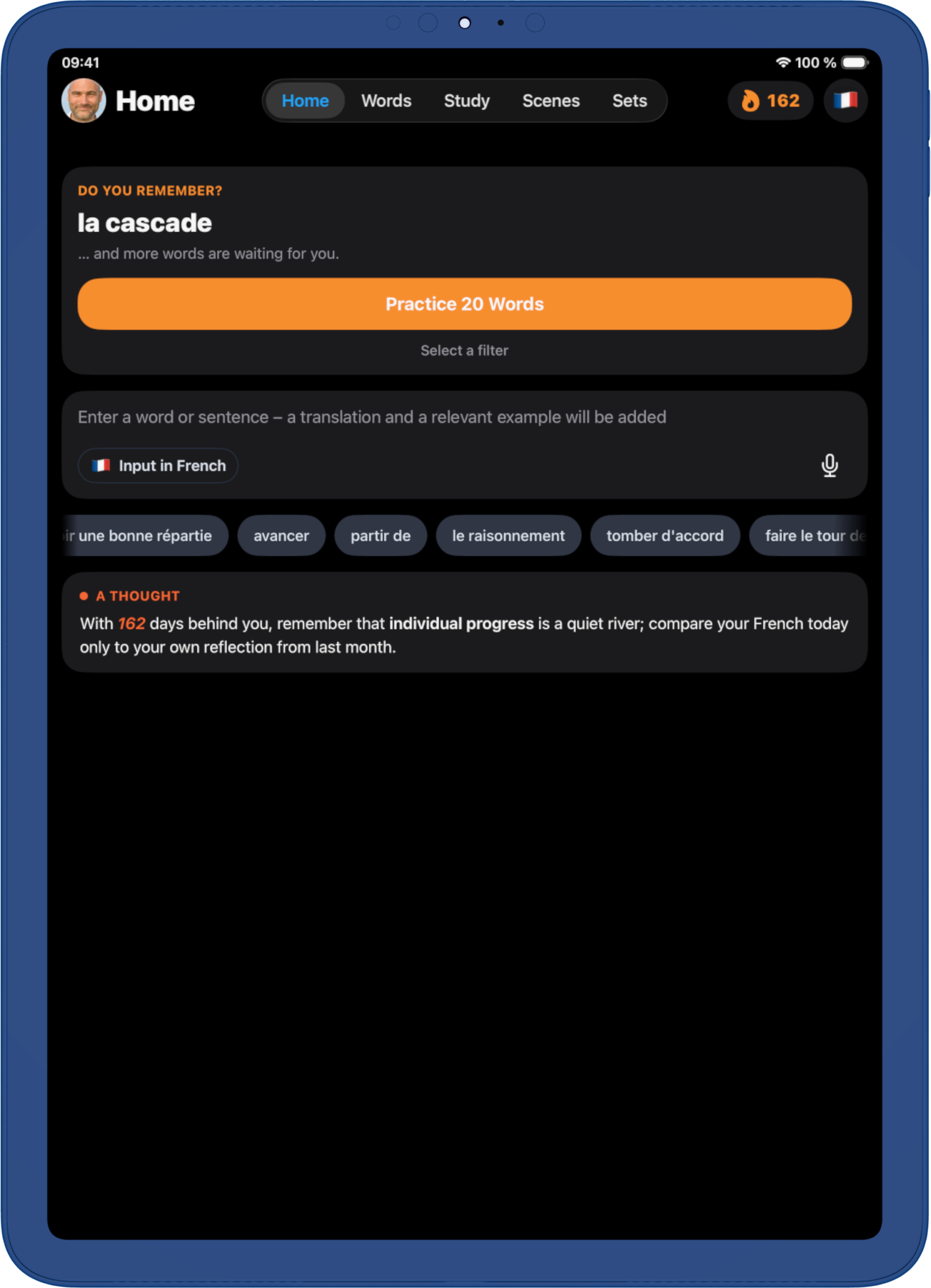
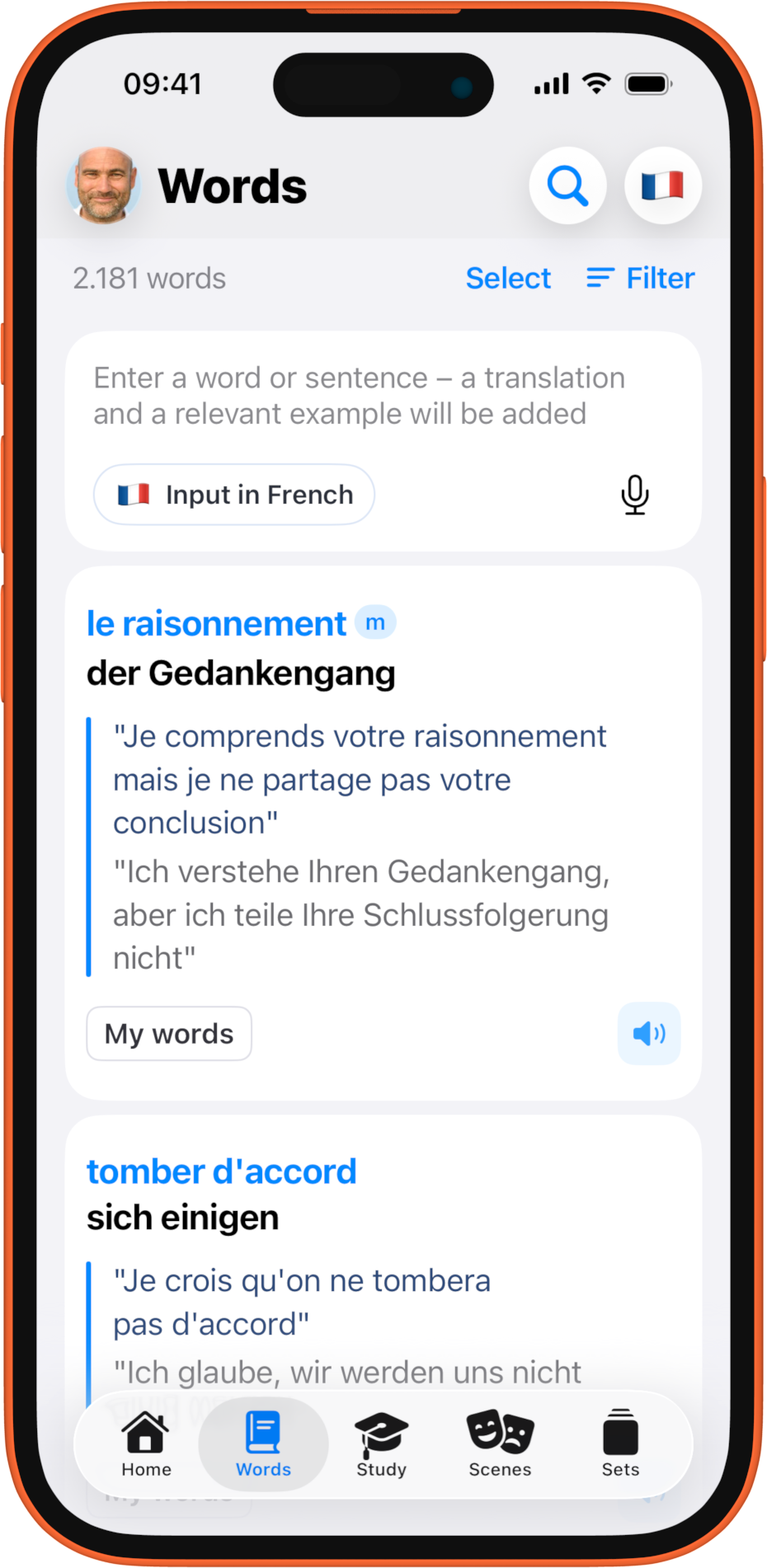
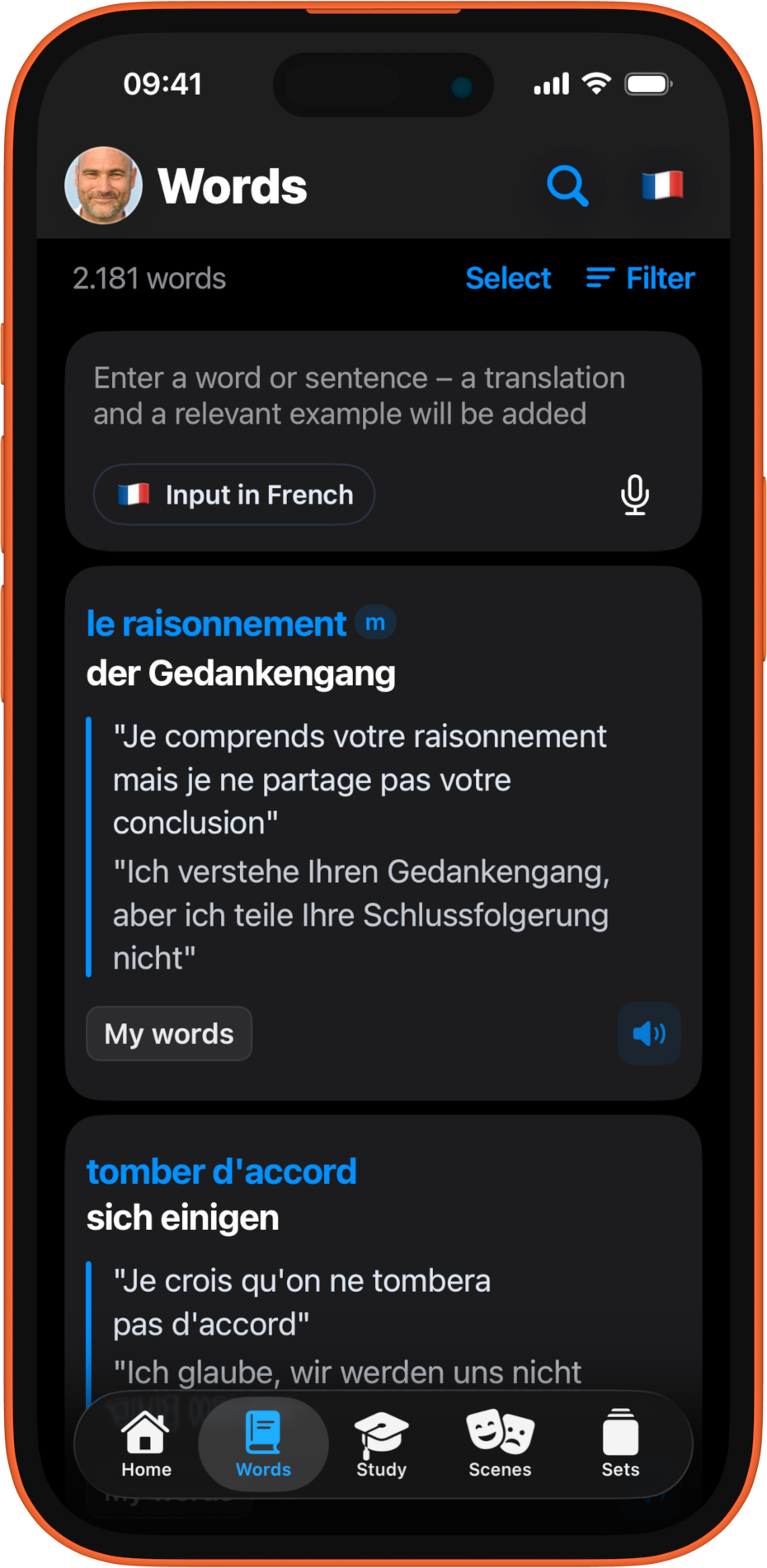
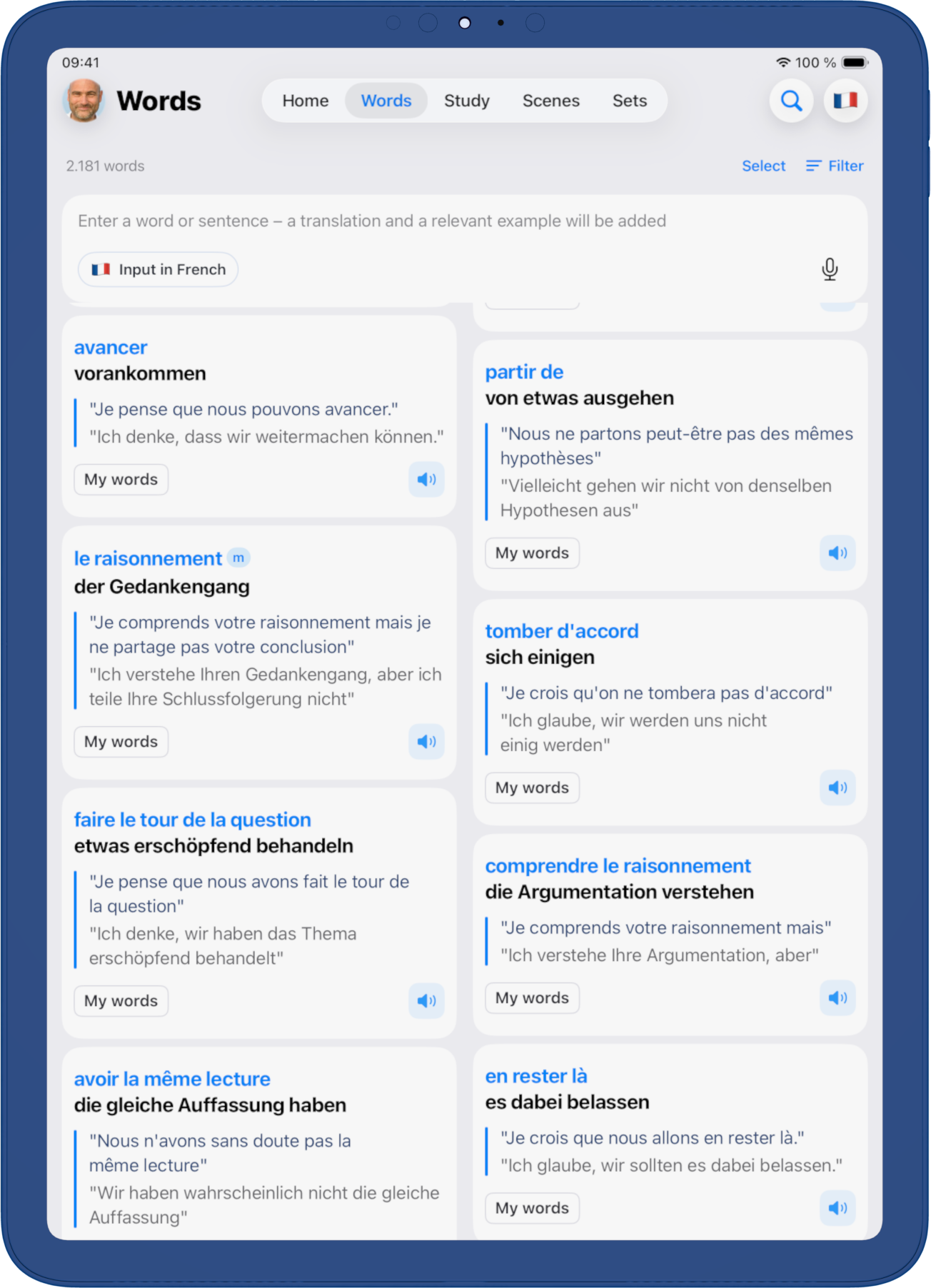
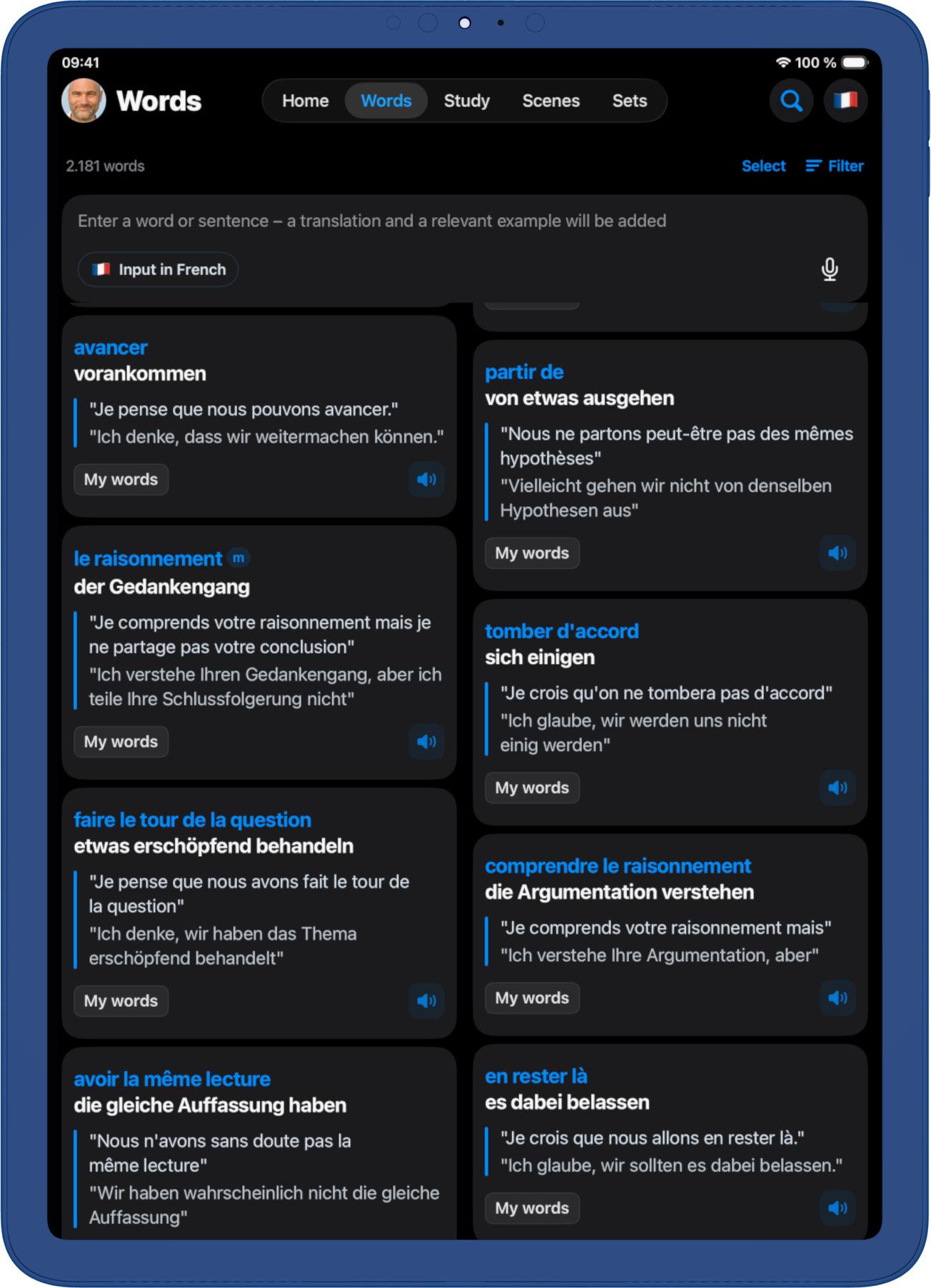
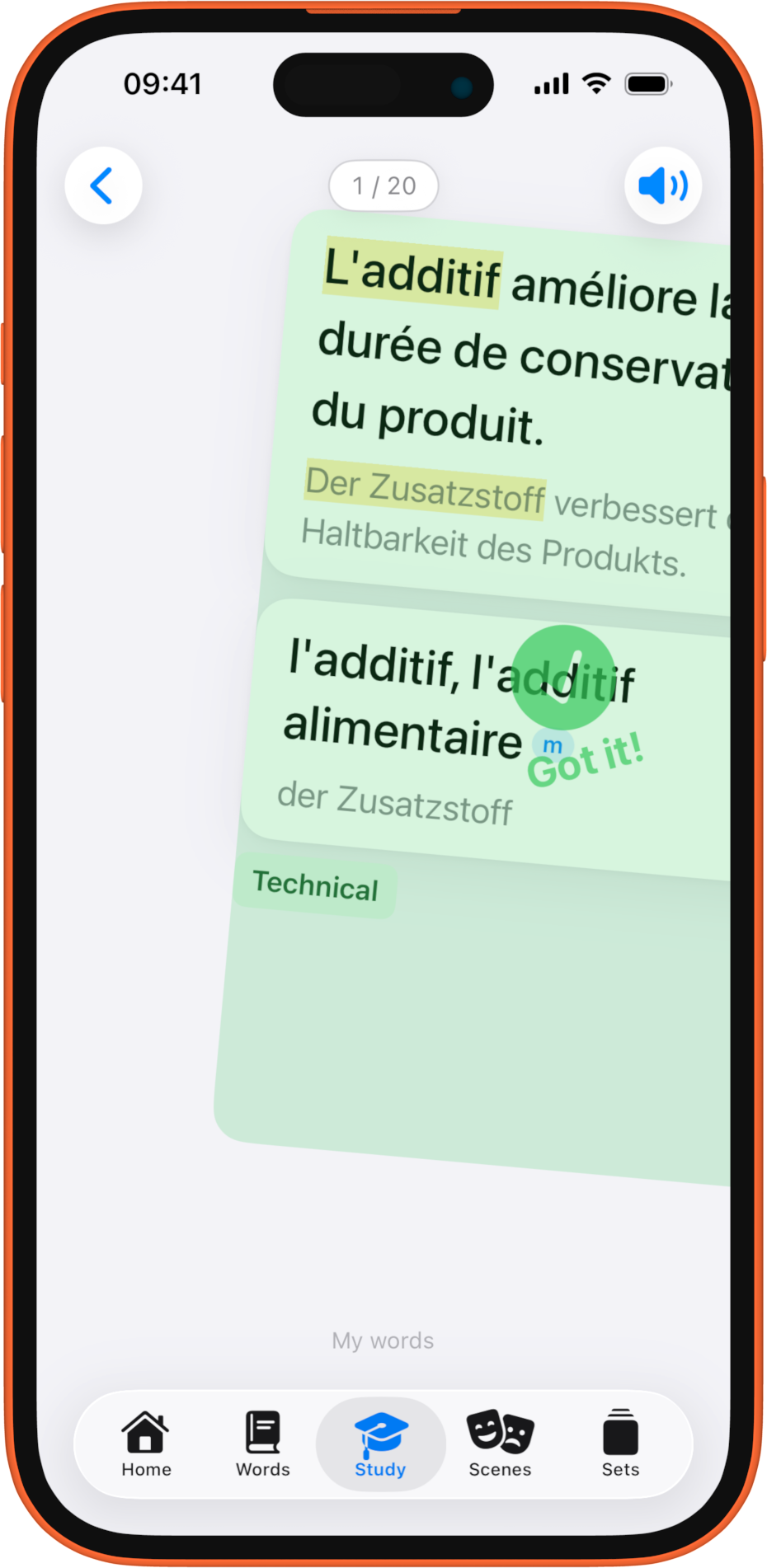
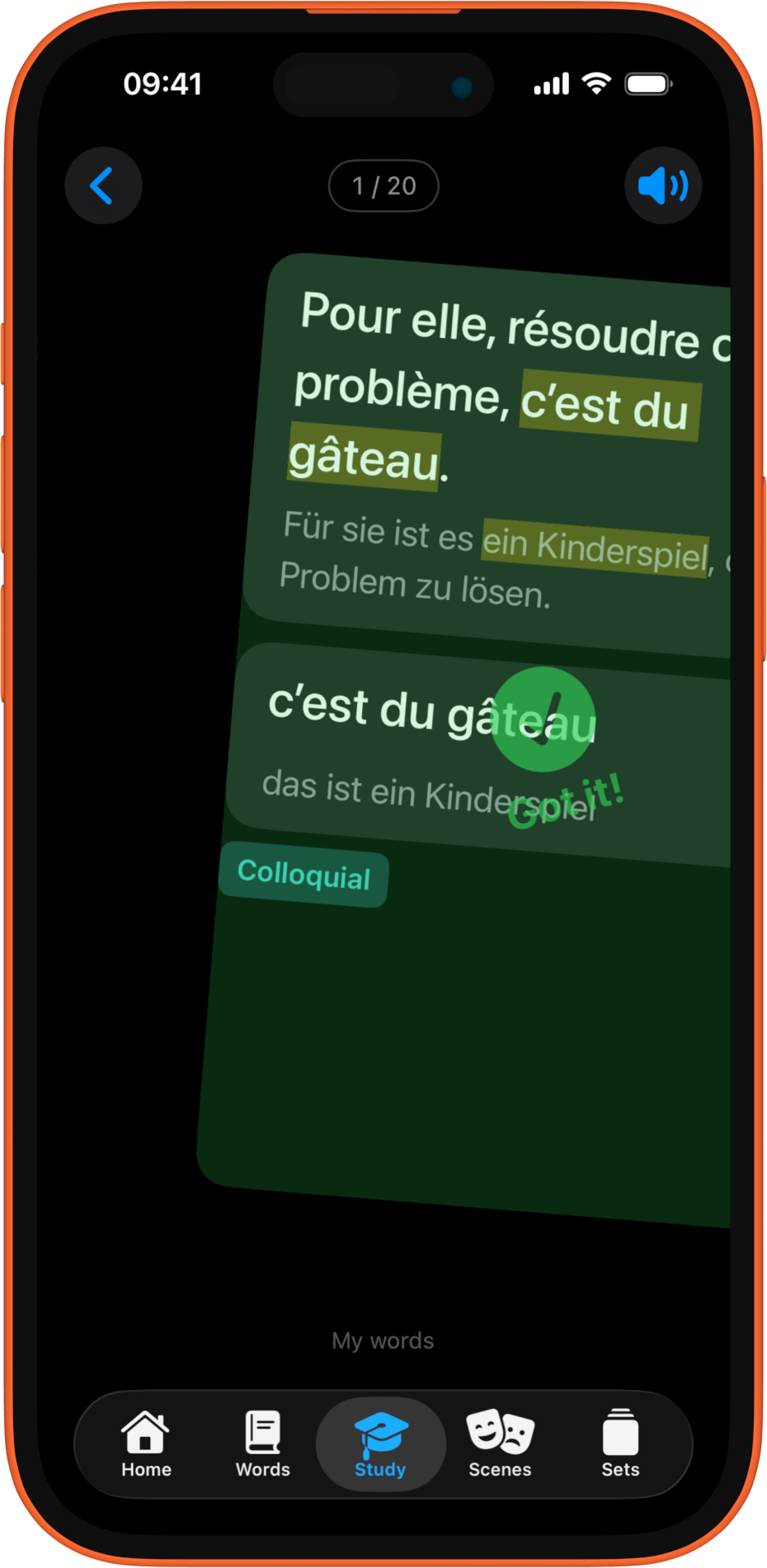
Words. A learner types or dictates anything they want to keep into a single field. Vokabulo supplies the translation, a natural example sentence and, where the word carries one, a usage label, so the learner knows whether they can say it to a friend or put it in an email. Everything can be edited before it is saved. Words can be tagged, searched and filtered, so a profession, a project or a move can be kept as its own collection.

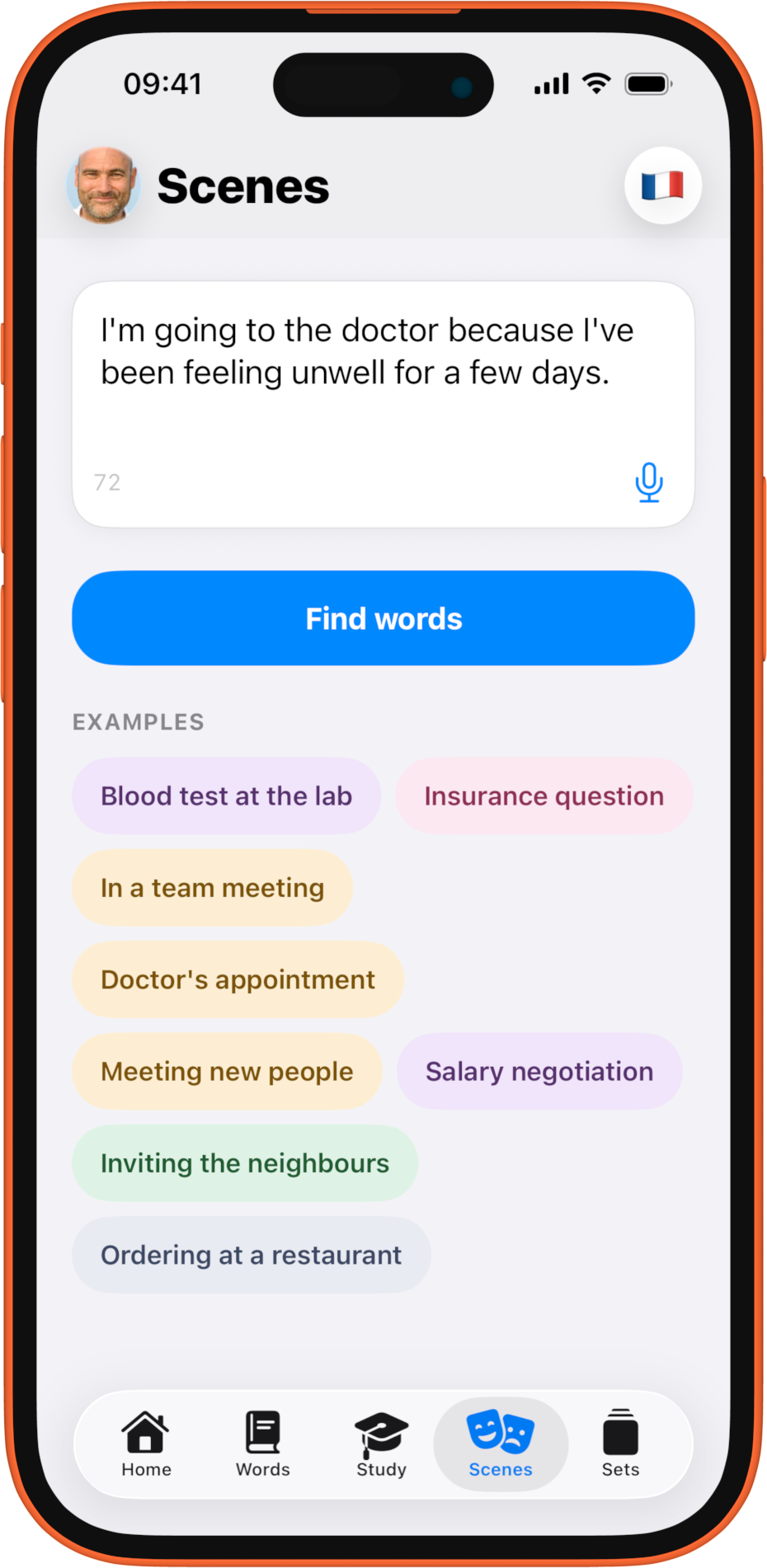
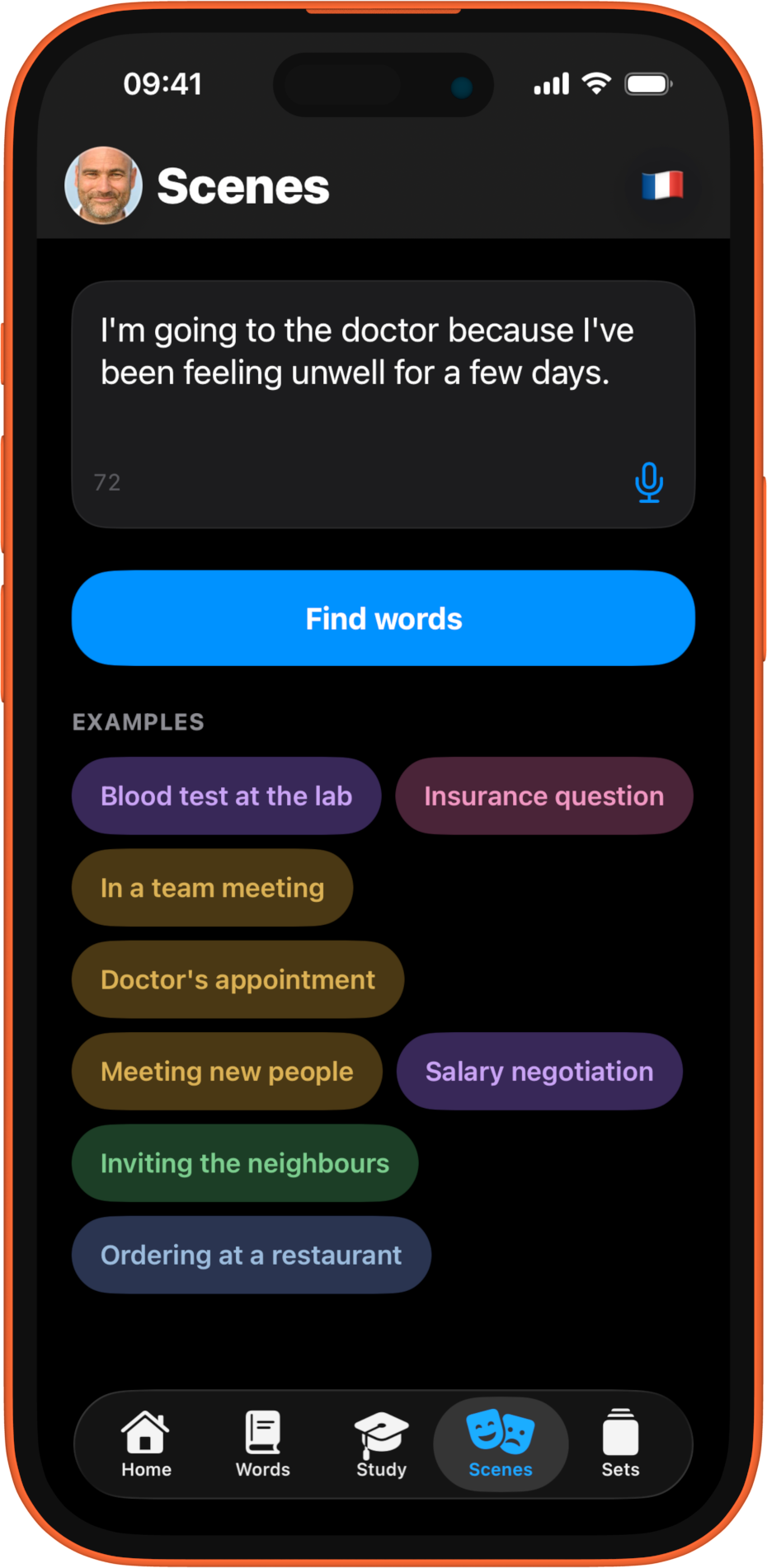
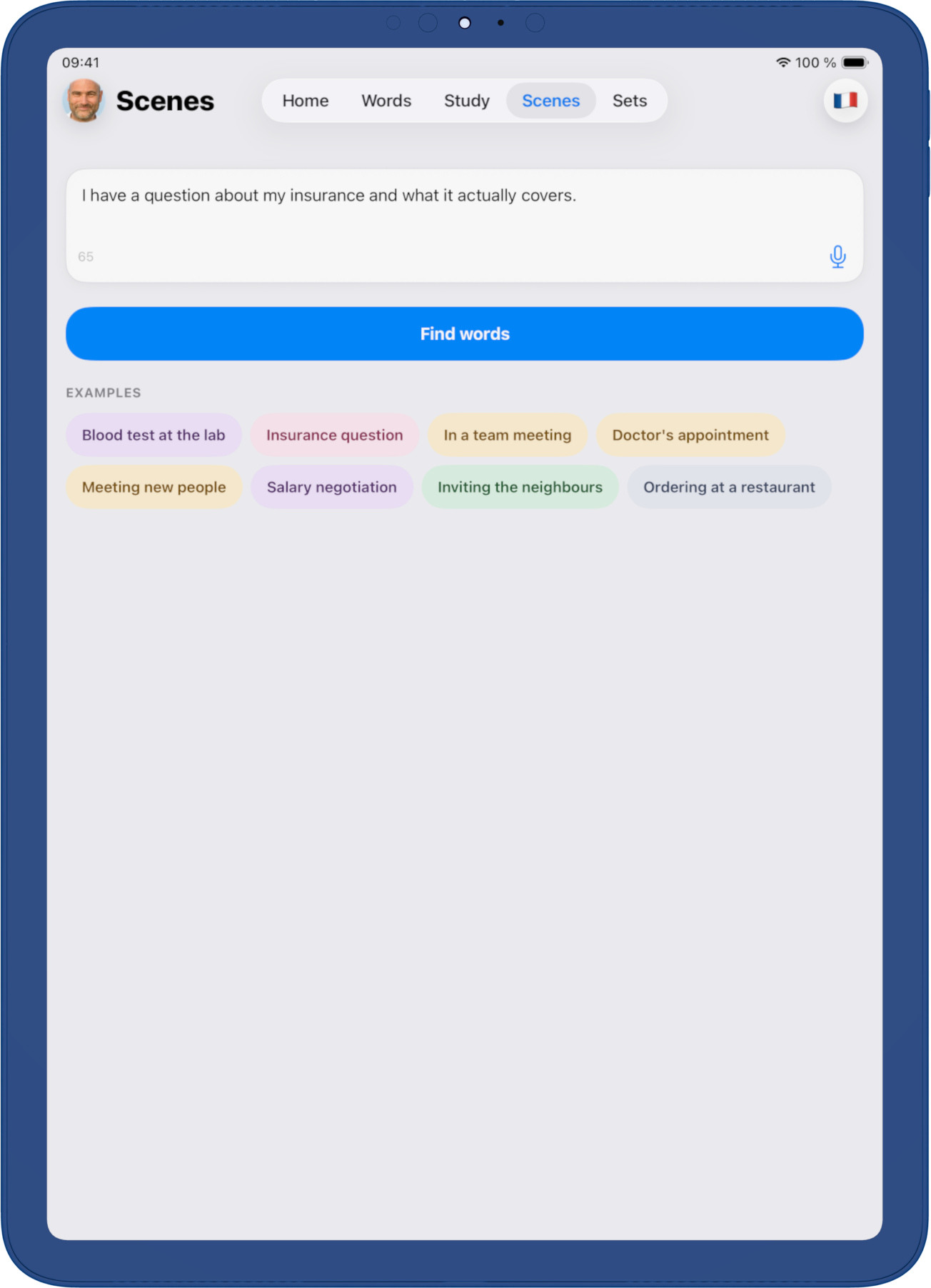
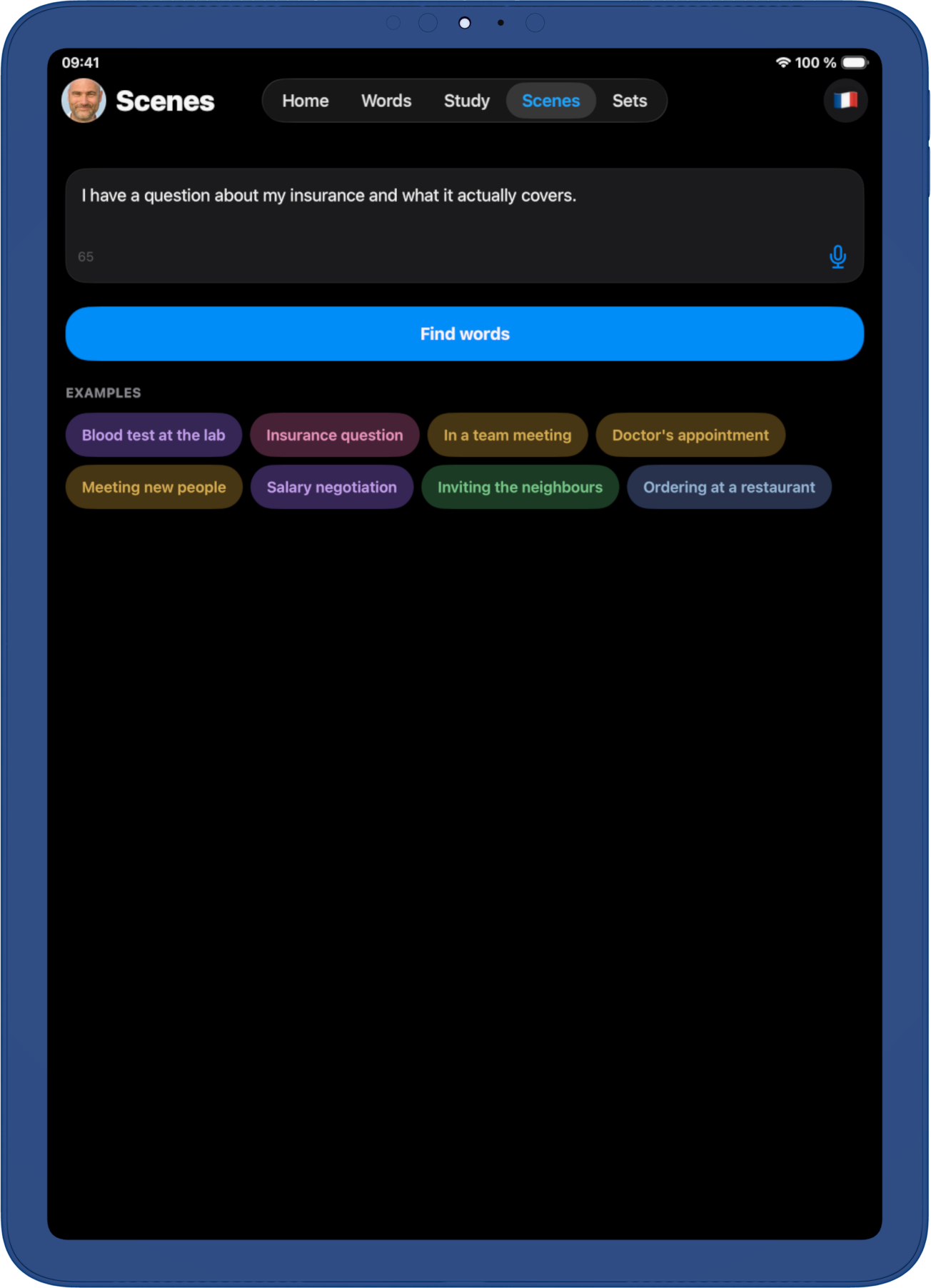
Scenes. The other direction. Instead of waiting to meet a word, the learner describes a situation they expect to face, negotiating a contract in French, viewing an apartment in Italy, dinner with a partner’s family, and Vokabulo writes the vocabulary and the example sentences for it, matched to their proficiency, in under a minute.

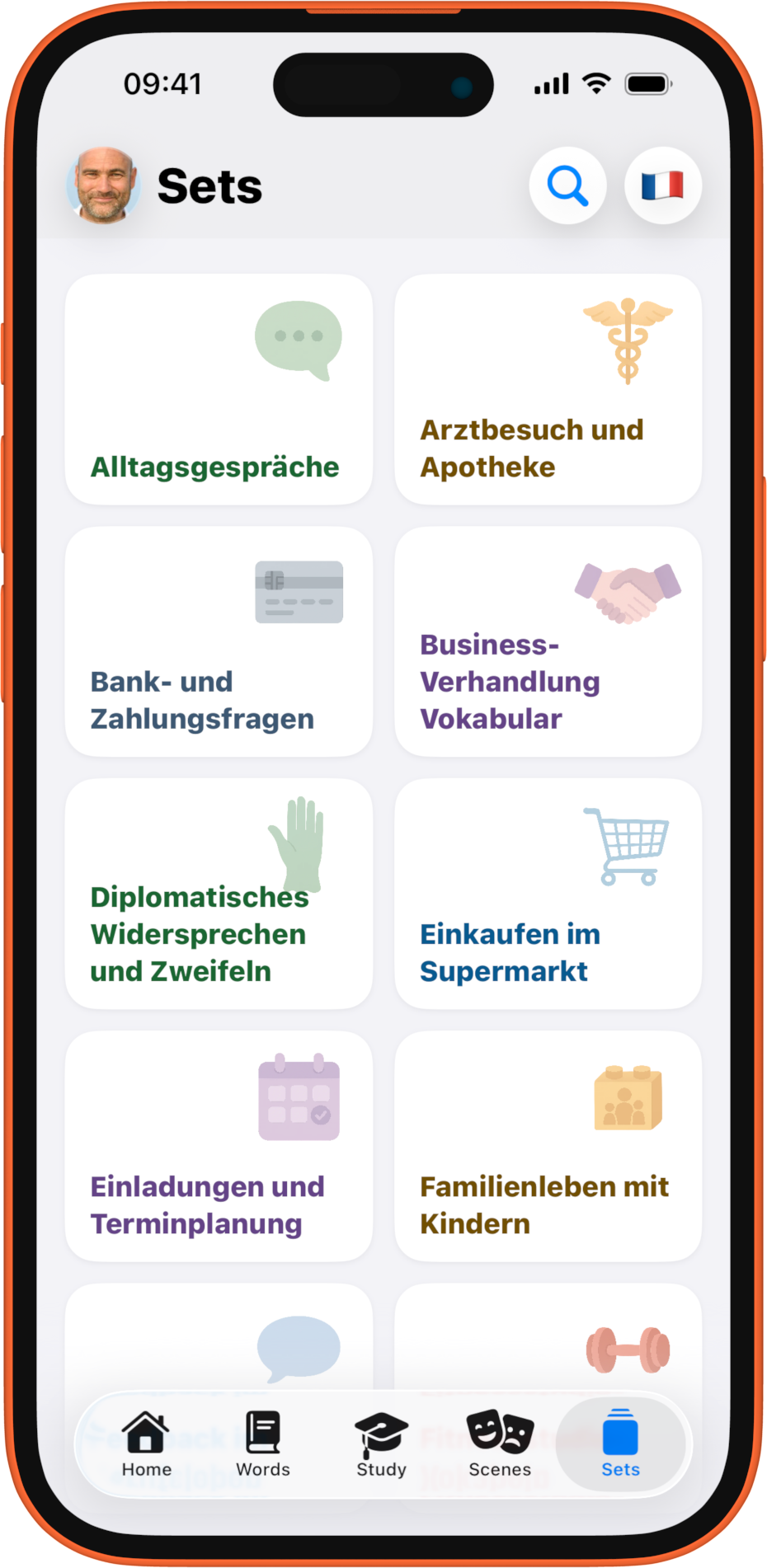
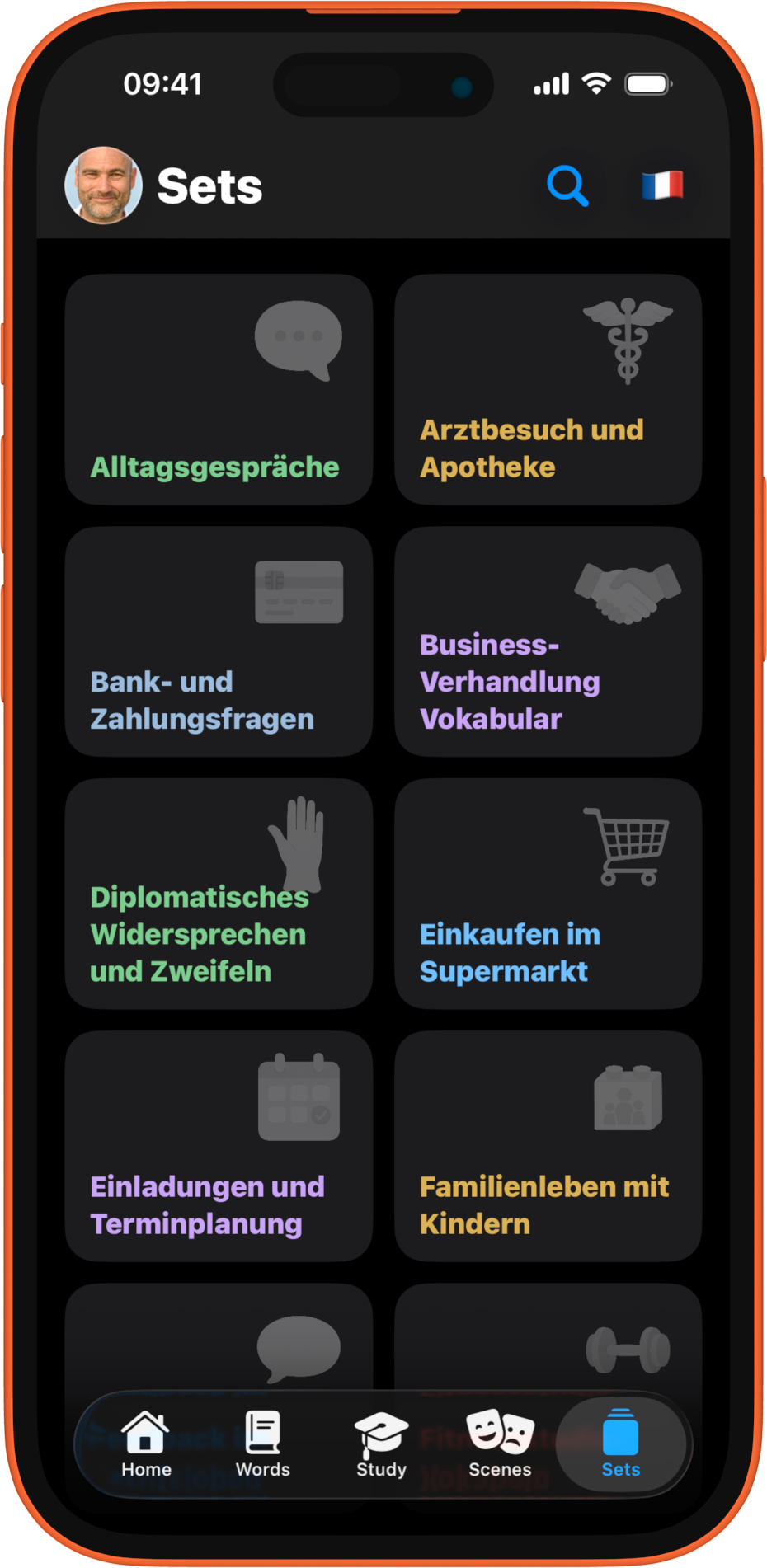
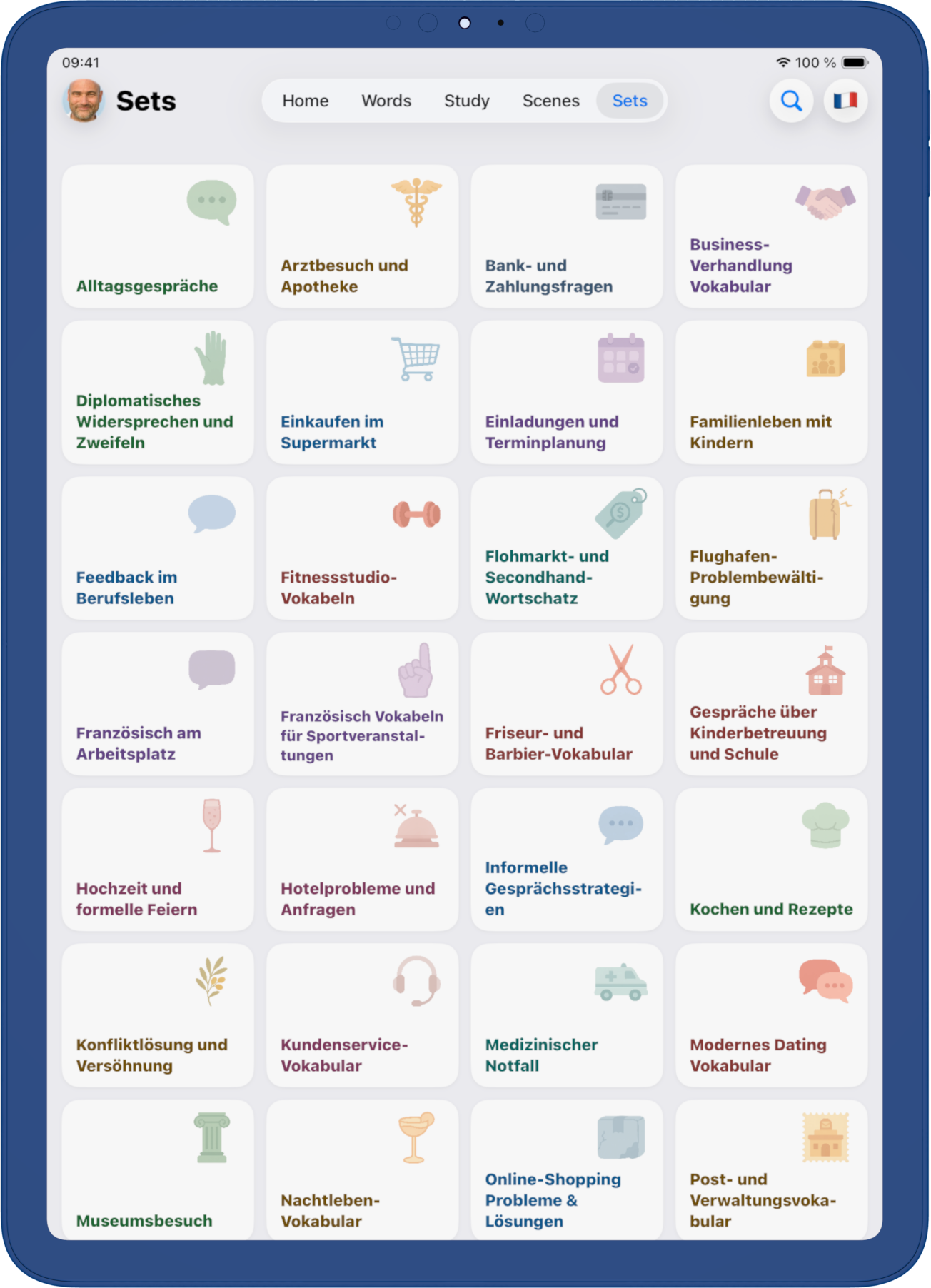
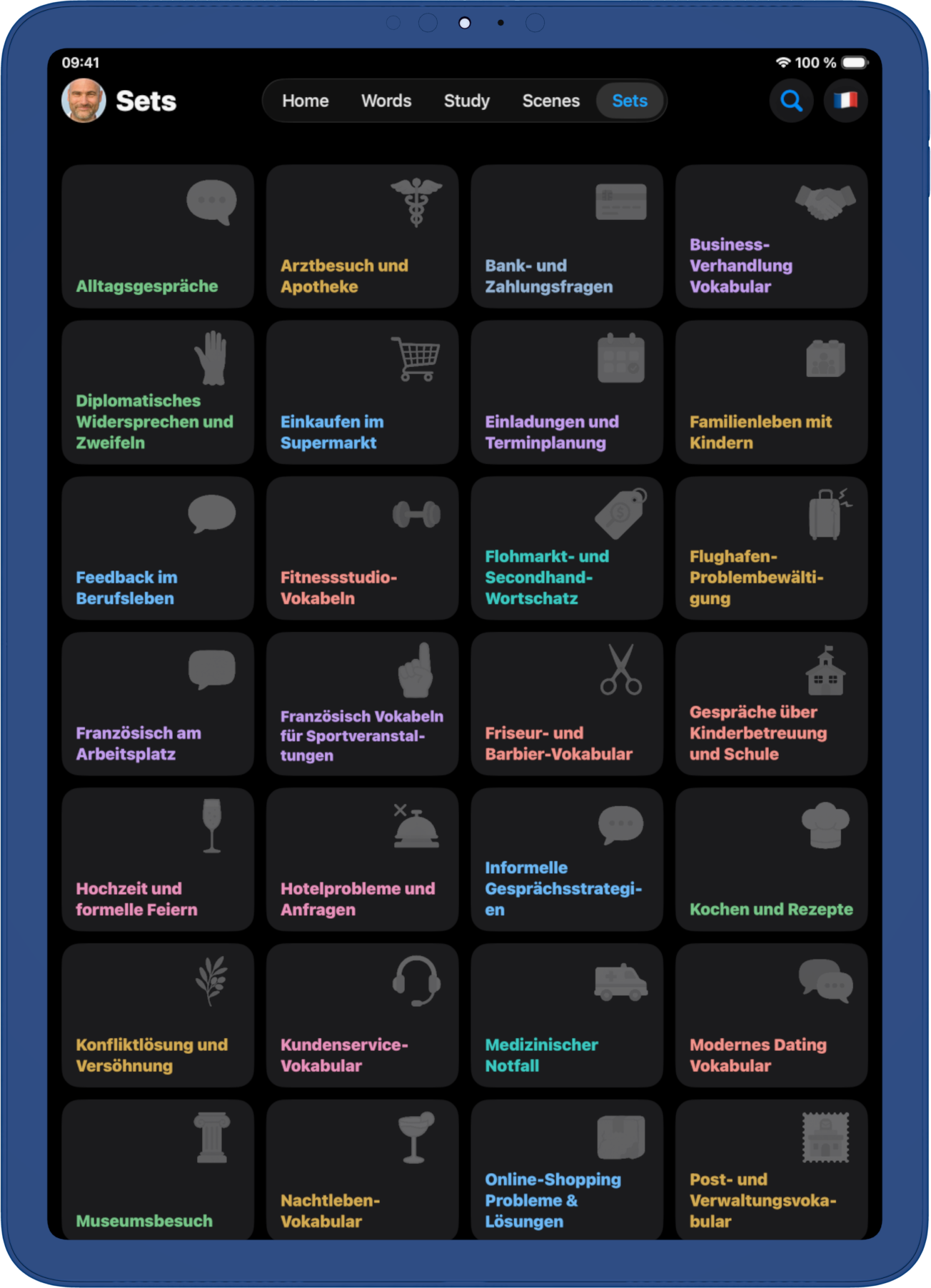
Sets. A third way in, for learners who would rather start from something finished than build from scratch. Sets are ready-made vocabulary packs for situations people actually face, from a job interview to a visit to the doctor.

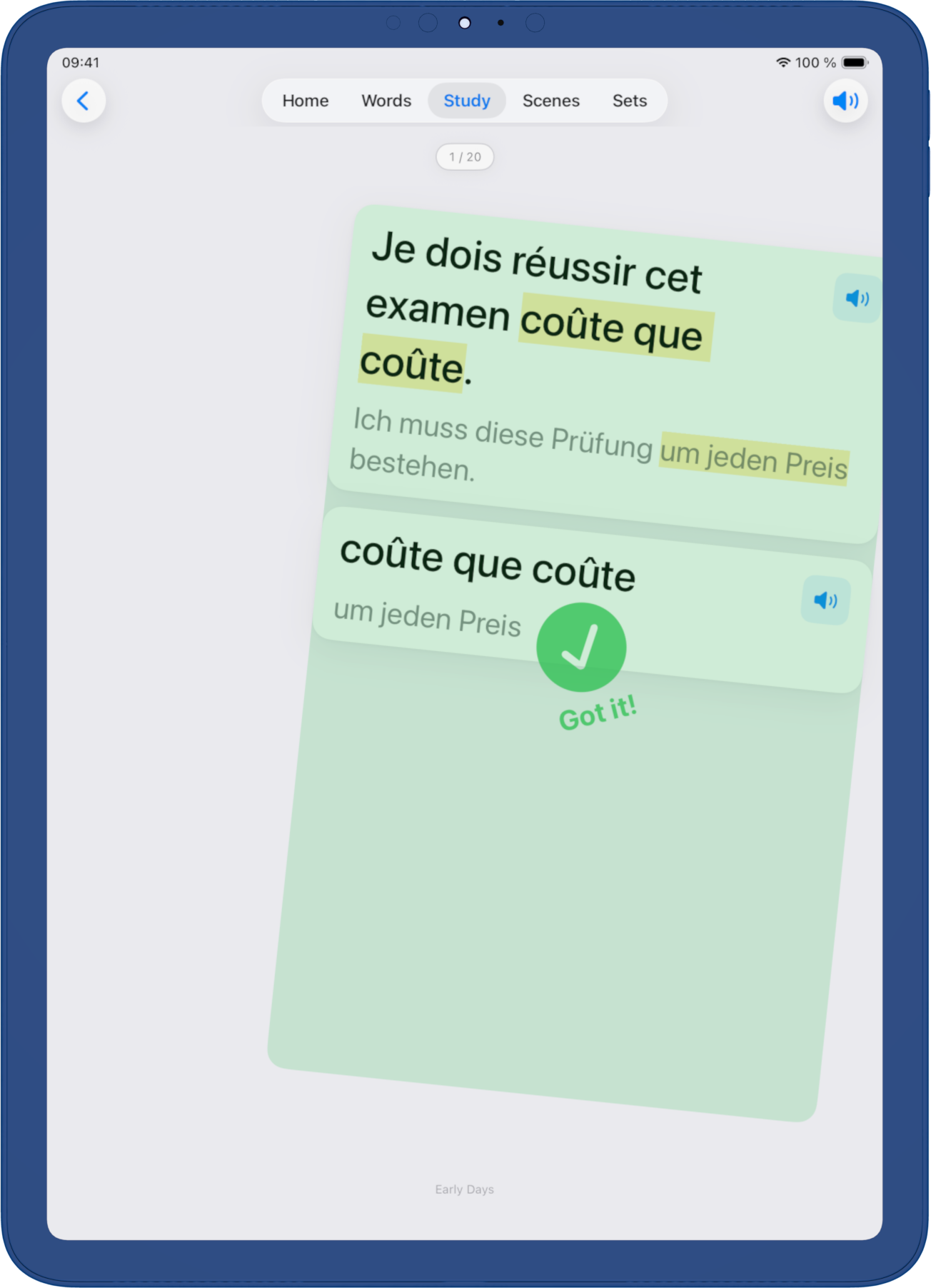
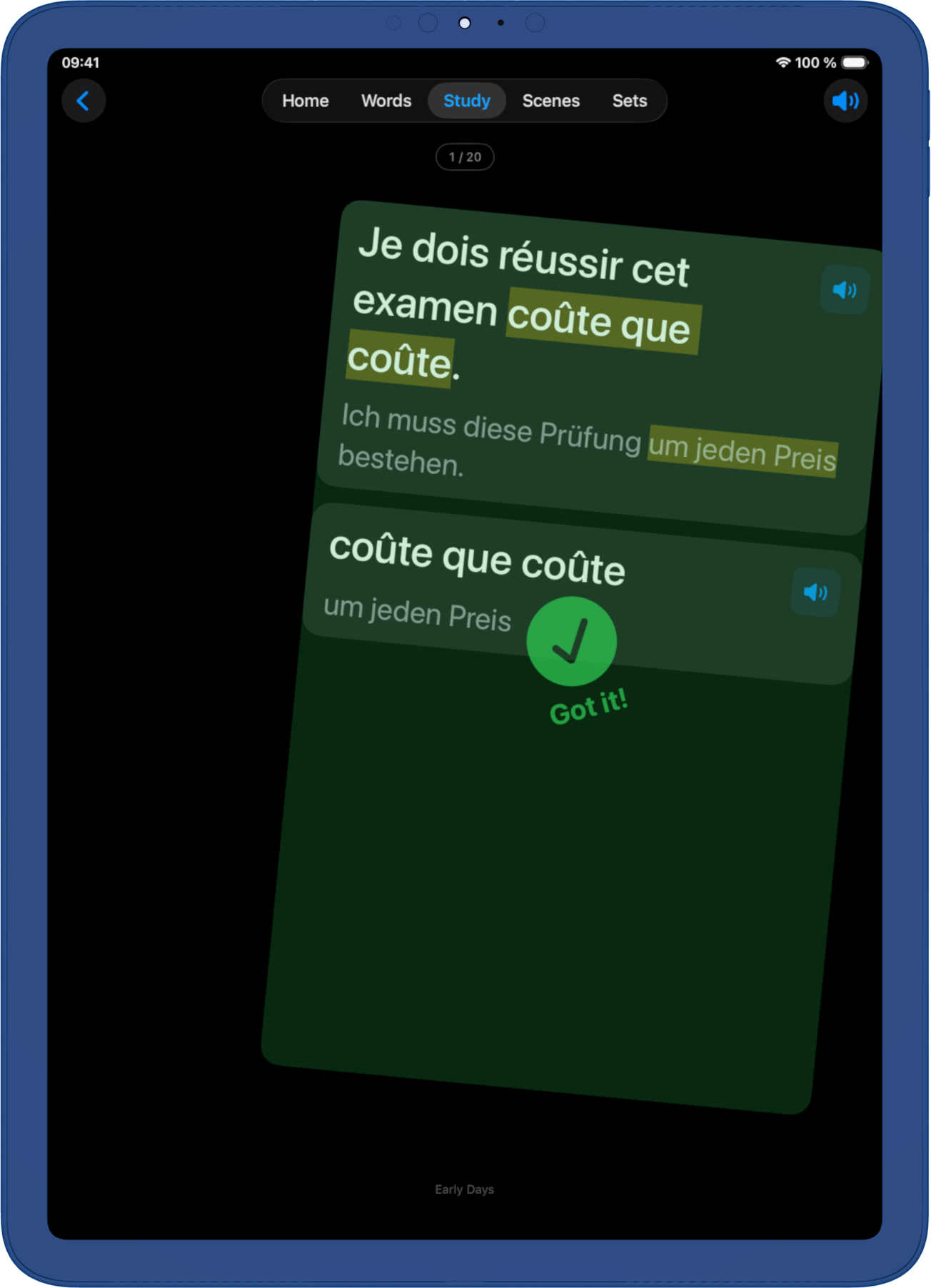
Study. Everything saved is scheduled for review rather than left in a list. Difficult words return sooner, secure ones return after progressively longer gaps, and sessions can be run by time, by number of cards, by tag or by proficiency, hands-free or offline. The method underneath is spaced repetition, and it rests on two of the best-established findings in learning research: practice spread out over time holds far better than practice crammed together, and a word retrieved from memory sticks far better than a word read again. It is also the step that separates the app from a dictionary or an assistant, because understanding a word once and producing it three weeks later are different problems.

What changes. The promise is not a larger word count. It is precision, saying exactly what you mean instead of the nearest thing you can recall; naturalness, sounding less like a textbook and more like the way people actually phrase things; range, no longer reaching for the same safe words in every conversation; and expression, saying more of what a person thinks, feels and notices instead of the nearest safe approximation. The learner stops sounding simpler than they are.

What it is not. Vokabulo does not promise fluency in a few weeks, does not teach grammar, and does not replace speaking practice, a teacher or a beginner’s course. Nor is it a game. It is quick and pleasant to work with, and there are streaks and a leaderboard for people who like them, but none of that is what the product is for: a good week is measured in the words a learner can now produce, not in a score they kept. Vokabulo does one thing. It turns the words a learner meets or anticipates into vocabulary they can retrieve when it matters.

Who makes it. Vokabulo is a native app for iPhone and iPad, designed and built by Wolfgang Männel and published by Tathros GmbH in Bad Soden am Taunus, near Frankfurt am Main. It supports more than 100 languages in any pair combination, syncs across devices and works offline for capture and study. The app’s own interface is available in English, German, French, Italian, Spanish and Portuguese.


Boilerplate

Vokabulo is a personal vocabulary trainer for people who already speak a second language and want to keep getting better rather than stagnate. Most apps and courses get a learner to B1. Vokabulo is built for everything after, where the words a person needs come from their own work, conversations and interests rather than from a syllabus. The gain is not only a bigger word count, but more precision, more natural speech, more range and more expression. Vokabulo supports more than 100 languages in any pair combination, is available for iPhone and iPad, and is free to start. It is developed by Wolfgang Männel and published by Tathros GmbH in Bad Soden am Taunus. vokabulo.com

Feature bullets

Each of these is a standalone fact and can be quoted without the ones around it.

Scope

  • Languages More than 100, in any pair combination, so a learner can study French from German or German from Japanese.
  • Proficiency Translations, examples and generated collections are matched to the learner’s stated proficiency, from A1 to C2.
  • Platform iPhone and iPad, requiring iOS 26 or iPadOS 26. There is no Android version.

Getting words in

  • Adding a word Typed or dictated into a single field. Vokabulo supplies the translation, a natural example sentence and, where the word carries one, a usage label. All of it can be edited before saving.
  • Scenes The learner names a situation they are about to face, such as a rental contract appointment or a client presentation, and Vokabulo writes the vocabulary for it in under a minute.
  • Sets Ready-made vocabulary packs for common situations, from a job interview to a doctor’s visit, added with a single tap. Words already saved are not duplicated.
  • Sharing Words can be shared with other learners, and the vocabulary of an article on vokabulo.com can be imported by scanning a QR code.

Making them stick

  • Review Every saved word is scheduled with spaced repetition and returns at roughly the point the learner is likely to forget it.
  • Sessions Study can be run by time, by number of cards, by tag or by proficiency, hands-free while walking or driving, and offline.
  • AI tutor Reads the learner’s own study data and reports what it shows, including when a review backlog has grown out of proportion to recent activity.
  • On the Home Screen A widget and a Lock Screen countdown show what is still due that day.

Data and devices

  • Sync and offline Vocabulary and progress sync across devices on one account, and capture and study work offline.
  • Export and import Vocabulary can be exported as CSV at any time, and imported from CSV or Excel.

Getting started

  • Free to start The free account stays free, with no end date. It is metered on six things: one language pair, 25 AI translations plus five more every 30 days, three Scenes in total, one article glossary, the AI tutor for the first 30 days, and no bulk import. Vokabulo Pro lifts all six.

Selected reading

Video

Five short films introduce Vokabulo and each of its main modes. All are hosted on YouTube and may be embedded in coverage without prior permission.

Watch on YouTube →

Media assets

The logo, wordmark and app icon. Screenshots are in the product gallery above, where every device in both themes carries its own download link.

All assets on this page may be used in editorial coverage of Vokabulo without prior permission. Please do not alter the logo, recolour it, or place it on a background that compromises legibility. Screenshots may be cropped but should not be composited with other products or overlaid with text that could be mistaken for part of the interface.

Apple’s trademarks, including the App Store badge and iPhone and iPad product imagery, remain subject to Apple’s own marketing and identity guidelines.

About the developer

A note from the developer

I have been looking at vocabulary apps for more than thirty years. Almost all of them are built for the same stretch of the journey: A1 to B1. The first thousand words, the present tense, enough to order a coffee and find the station. That stretch is well served, and it is the easy one to build for, because at that level everybody needs the same words.

After B1 the help stops. That is exactly the point at which useful vocabulary stops arriving on its own. Nobody teaches you the word your landlord just used about the boiler, or the clause in a contract that everyone else at the table seemed to find perfectly clear. You are not a beginner. You are not struggling with grammar. You keep hitting walls made of words you do not yet have.

I tested more than fifty language apps before I built anything. They teach that the apple is red. They hand you a word stripped of the sentence it lives in, which is the least useful form a word can take.

So in August 2025 I started building the app I had spent thirty years waiting for somebody else to build. I built it for myself. It turned out to be most useful to people whose lives happen in a second language: people who have moved somewhere, people who work across languages, anyone who is past the basics and still short of the words.

Building it also taught me what AI is actually good for in language learning, as distinct from what the marketing says it is good for. It is not replacing a teacher, simulating a conversation partner, or gamifying somebody’s commute. It is catching the specific words a person meets in their own life, explaining them in context, and making sure those words come back.

Wolfgang Männel, developer of Vokabulo, Bad Soden am Taunus

Short biography

Wolfgang Männel is the independent developer of Vokabulo, an AI vocabulary trainer for people who already speak another language but want to express themselves more precisely.

A graduate of the European Business School in Oestrich-Winkel, he spent his career in marketing, consulting and private equity, much of it internationally. He designed and built Vokabulo himself and publishes it through Tathros GmbH in Bad Soden am Taunus, near Frankfurt am Main.

He has been following education software closely since the 1990s and takes a restrained view of the category: many apps optimise for engagement rather than for progress. He does not believe AI removes the reason to learn a language, because instant translation is not the same as being understood as yourself.

He is available for interviews in German, English and French.

Interview topics

Beyond the product itself, Wolfgang Männel can discuss: why language learners plateau at the intermediate level and why that plateau is mostly a vocabulary problem; why vocabulary becomes personal once grammar is no longer the constraint; where general-purpose AI really helps in language learning and where it quietly fails; and why fluency is situational rather than a single level, so that a confident professional speaker can still be lost at a parents’ evening.

Selected quotes

“Once you can speak a language reasonably well, progress becomes deeply personal. You do not need another generic lesson about ordering a coffee. You need the vocabulary for your work, your interests, and the conversations you actually want to have. Vokabulo was built to turn those moments into lasting vocabulary.”

Wolfgang Männel, developer, Vokabulo

“I could already speak German, but I kept reaching for the same simple words. Since using Vokabulo I notice the everyday words much more, and I put them straight into the app. It helps me learn the words I actually need, in meetings, with friends, and in the small conversations that make up my day.”

Aude Langlois-Meurinne, French expat in Germany for twenty years

“My German is decent, but since I started using Vokabulo, my everyday vocabulary has noticeably widened.”

Sagar Barvaliya, Indian expat in Germany for twelve years

Press FAQ

What do you mean by the plateau?

The point at which grammar stops being the obstacle and vocabulary stops growing with the learner’s life. It usually arrives around B1. The learner can work, shop, get through a meeting and read without a dictionary, and still reaches for the same few hundred safe words under pressure, so what comes out sounds simpler than the person speaking.

The arithmetic is the clearest way to see it. The first thousand words belong to everyone, which is why beginner material works. The next five thousand are personal, which is why nothing after B1 can be taught from a shared syllabus. The learner is not stuck. They are missing words.

Who is Vokabulo for?

Learners from B1 upward who use another language in everyday life: expatriates, international professionals, students, and people whose relationships or interests regularly place them in another language.

It is particularly useful for people who can already communicate but rely on the same basic words, understand more than they can actively say, or keep forgetting words they have looked up before.

Beginners can use it, but it is not a replacement for a structured beginner course.

What problem does it solve?

In the learner’s words: “I am not a beginner. I am just tired of sounding simpler than I am.”

Courses decide in advance what learners should study, which works up to B1 and stops working after it. Dictionaries and AI assistants explain words but do not ensure they are remembered. Flashcard apps provide repetition but require considerable manual work.

Vokabulo combines capture, contextual understanding, organisation and long-term review in one place. It is not a complete language course: it has no curriculum of grammar lessons, dialogues or examinations, and it complements teachers, reading and conversation practice rather than replacing them.

What are Scenes?

Scenes let learners describe a situation they expect to encounter, negotiating a contract in French, viewing an apartment in Italy, taking a cooking class in Barcelona, and Vokabulo generates a collection of relevant words and phrases matched to their proficiency. The learner can save the collection and study it like personally captured vocabulary.

What are Sets?

Sets are ready-made vocabulary packs built around specific subjects and situations, from a job interview to a doctor’s visit.

Is this not a crowded market?

The beginner end is crowded, and deservedly so.

Above B1 it thins out quickly, because the product problem changes shape. A course needs a curriculum, and there is no sensible linear curriculum at C1. A shared flashcard collection has to answer “which words should a B2 learner know?”, when the useful question is “which words does this particular person need?”. A tutor produces exactly the right vocabulary during a lesson, and then the lesson ends and that vocabulary disappears unless somebody writes it down. A general assistant explains any word beautifully and remembers none of them.

Vokabulo does not compete with any of those on their own ground. It does the part each of them leaves behind, which is turning the words one specific person meets into vocabulary they can still produce months later.

How is it different from Duolingo?

Duolingo provides a structured, gamified course built largely on predetermined content, and it is very good at introducing a language from scratch. Vokabulo starts from the individual learner instead: there is no universal vocabulary curriculum to progress through, because the learner builds a personal one from encountered words, upcoming situations and Sets. The two are complementary rather than competing. Duolingo can get someone started; Vokabulo helps them expand beyond a standard course.

How is it different from Anki?

Anki is a powerful and highly flexible flashcard system, and for learners who want complete control it remains excellent. The cost of that flexibility is that users generally have to create or source their cards and configure much of the learning experience themselves. Vokabulo generates translations, examples, pronunciation and complete situational collections automatically, keeping the benefits of spaced repetition while reducing the work required before studying can begin.

How is it different from ChatGPT?

ChatGPT is excellent at explaining a word, generating examples and answering language questions, often better than a dictionary. It is not, however, a personal vocabulary database or a dedicated spaced-repetition system. Vokabulo stores the word, preserves its context, tracks the learner’s performance and returns it for review when needed.

The two work well together: many learners use a general assistant to understand something and Vokabulo to remember it.

Which languages and devices are supported?

Vokabulo supports more than 100 languages in any combination of learning and reference language: French from German, Portuguese from English, German from Japanese. The quality of AI-generated translations, pronunciation and examples may vary for less widely supported languages.

It is a native app for iPhone and iPad and requires iOS 26 or iPadOS 26. Android is not currently supported. Vocabulary and progress synchronise between devices on the same account.

Is it free?

Vokabulo is freemium. The free account stays free and has no end date, so nothing expires and no trial runs out. It is metered on six things: one language pair at a time, 25 AI translations plus five more every 30 days, three Scenes in total, one article glossary, the AI tutor for the first 30 days, and no bulk import of the learner’s own word lists.

Everything else is unlimited on a free account, including adding words by hand, quiz and spaced-repetition practice, streaks, sharing words, and importing shared Sets.

Vokabulo Pro lifts all six limits; it does not unlock a different app.

Pro is $69.99 a year in the US, £59.99 in the UK and €69.99 in Ireland and the rest of the eurozone, which works out at $5.83, £5.00 or €5.83 a month. Pro Family covers up to six people for $99.99, £99.99 or €119.99 a year, which is $1.39, £1.39 or €1.67 per person per month. A monthly plan is also available, at €12.99 in the eurozone.

Apple sets prices per storefront, so they differ by country and are always shown before purchase in the app. Subscriptions are managed through the user’s Apple account and can be cancelled at any time in App Store settings.

Can AI-generated translations or examples be wrong?

Yes. Generative AI can produce inaccurate, unnatural or inappropriate suggestions, and Vokabulo does not present it as an infallible authority.

Learners can review and edit any generated content before saving it. Particular care is warranted with legal, medical, technical and culturally sensitive language. Examples and generated collections are matched to the learner’s selected proficiency, which improves relevance but cannot perfectly assess every learner’s ability.

How is user data handled?

Personal vocabulary and learning activity are processed as described in the Vokabulo privacy policy, available at vokabulo.com.

Learners can export their vocabulary at any time, and it remains associated with their account if a subscription ends. Paid features may become unavailable until the subscription is renewed, but a learner’s own words are never withheld from them.

Press contact

Wolfgang Männel
Developer, Vokabulo
Bad Soden am Taunus, Germany
press@vokabulo.com