
There is a particular kind of frustration that only happens in a language you already speak well.
Beginners never feel it. They are forgiven everything: you say le instead of la, people smile, and someone helps you finish the sentence.
It comes much later, and usually on the way home.
The replay
You've had a long evening in French. Dinner with friends you've known for thirty years. You followed every word, and your jokes landed.
Now you're walking to the car, replaying it. Not to enjoy it, but because somewhere in the middle of the evening you said the second-best thing.
Somebody said something you disagreed with, and you wanted to say, in one precise word, that he wasn't wrong, he was beside the point. You didn't have the word. So you went around it: six words where two would have done. Everyone was polite. The conversation moved on.
Twenty minutes later, the word arrives. Of course it does. You'd read it dozens of times. You just didn't have it when you needed it, which means, in any way that counts, you didn't have it at all.
This is not a fluency problem
For years I misread this problem, and it cost me a great deal of wasted effort.
It isn't that I can't speak French. I spent half a year in Paris as a student in 1986 and have been going back ever since, for work and on holiday. Some of my friendships there date from that first year.
Over the years, French has taken me into rooms I never expected to be in: breakfasts with former prime ministers and mayors, meetings inside ministries, conversations with people who went on to become leading figures in European banking. I managed every time. And I left a good many of those rooms replaying the conversation on the way to the taxi.
The problem is subtler than not being able to speak, and more painful.
Above a certain level, you stop saying what you mean and start saying what you can.
You develop a repertoire of reliable moves, and you get so good at going around the words you don't have that nobody notices. Most of the time, not even you.
What you lose isn't comprehension. It's precision and humour, the ability to be as sharp, as warm or as funny as you are in your own language. You become a slightly flatter version of yourself, and nobody sees it except you, at eleven o'clock at night, on the walk to the car.
The distance between what you mean and what you can actually say is where your real vocabulary lives.
Thirty years of looking
I have been looking for something to close that distance since the early days of the internet.
Some of that was professional. By day I'm an investor, and taking products apart is what I do: install the thing, use it properly for a week, read what the users complain about rather than what the marketing says, work out what the company is really betting on.
So I looked at all of them. The famous green one. The flashcard ones. The ones with real native speakers. The one where you talk to your phone and it tells you your accent is fine, when you know perfectly well it isn't. Courses, dictionaries, browser plug-ins, a shelf of books.
And I put every one of them down. Not because they're bad products: several are excellent for the people they were built for. I just wasn't one of those people. Here is what I kept running into.
They teach you their words, not yours. Every course is a stranger's careful guess about your life. That's exactly right at the beginning, and useless later.
They test recognition, not possession. Four options on a screen, you tap the right one, you feel clever. But you would never have come up with that word yourself, and almost every product measures the easy part.
They hand you a translation and call it a meaning. Word on the left, word on the right. But doch has no translation. Neither does gemütlich, which is not "cosy", as any German who has spent a winter in England will tell you. Try explaining cheeky to a French person. Words carry their meaning inside sentences, not on their own.
They treat adults like children. Points, badges, streaks, a cartoon animal being visibly disappointed in me. I'm old enough not to need to be tricked into fifteen minutes.
And the serious tools are a hobby in themselves. There are good power-user tools, and the people who love them really love them. But one proper card is fifteen minutes of work: the word, the context, a real sentence, ideally the audio. So you don't make it.
The ten-second problem
That last point is the heart of it, and it took me years to see it clearly.
The words you actually need never turn up at a convenient moment. They turn up in a meeting, in a novel on a plane, in a radio interview at half past seven in the morning while you're making coffee. You get ten seconds of attention, if that. If capturing the word takes longer, you don't capture it.
So it's gone. And six months later you meet it again and think: I know you. I've looked you up before.
Le cas échéant means something like "if it applies", or "should the case arise", or "where relevant", and no short English or German equivalent quite manages it. I have looked it up three times in my life.
Three times. That is not a memory problem. That is a tooling problem.
Word five thousand belongs to you
It took me most of those thirty years to understand why nothing on the market could help me, although the clue had been in front of me the whole time.
My French had a shape. In some situations I felt almost like one of the family. An hour later, in a different sort of conversation, I'd be groping for words a fifteen-year-old would have had. Same language, same person, often the same evening. For years I took that as proof that my French was patchy and that I ought to work harder. That isn't what it means at all.
The beginner's vocabulary is generic. The advanced vocabulary is personal.
The first thousand words belong to everybody: bread, water, Monday, thank you, where is the station. They're the same for everyone, which is why a single company can serve a hundred million learners with one list. That's a good business, and it helps millions of people.
But word five thousand belongs to you alone.
My five-thousandth French word and yours have almost nothing in common. Mine come out of finance, out of wine, and out of arguing with friends at a dinner table. A doctor's come off the ward. A British lawyer in Frankfurt am Main has a completely different five thousand.
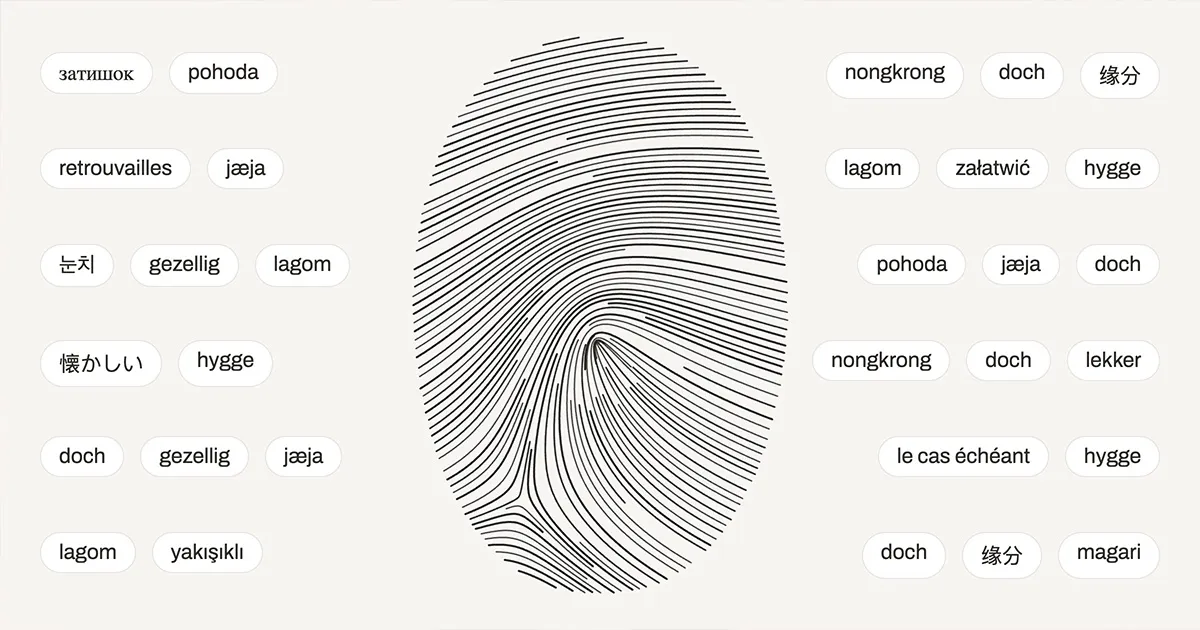
Your advanced vocabulary is closer to a fingerprint than to a syllabus, and so are its gaps. It runs deep where your life has been deep and thins out where your life hasn't gone yet. That is why you can feel like family in one room and like a beginner in the next.
So no publisher, no school and no app can write that list for you. Not because they're lazy, but because the list can't be written. There is no course for the words you actually need, and there cannot be one.
Depending on the day, that's either depressing or liberating. Eventually, for me, it became a product.
Why this wasn't possible until now
For the last fifteen of those years, I knew exactly what I wanted.
I meet a word and type it in within ten seconds, before the moment passes. Two seconds later I have it inside a real sentence, written for my language pair, my level and roughly the kind of life I lead. Then something asks me about it next week, and the week after, until the word is mine.
That was the whole wish, and it couldn't be built. The reason still fascinates me.
Computers have been able to translate for decades, badly at first, then quite well. But translation was never the problem. The sentence was the problem.
Writing a good example sentence for your word, in your language pair, at your level, about the things you actually talk about, was human work. A publisher can pay for that for the thousand words everybody needs. Nobody could ever pay for it for the four thousand words that only you need.
That changed about two years ago. Quietly.
What Vokabulo actually is
Vokabulo has no course in it. No lessons, no placement test, no chapter three about ordering in a restaurant.
That sounds like a weakness. It is the entire point.
Setting up takes about four taps: you choose your languages, add your first word, and you're running. Within a minute you have something no textbook could ever have printed, because no textbook has ever met you: a vocabulary made only of the language of your own life. And unlike a textbook, it gets better every week you use it.
You don't have to start from a blank page, though. Sets and Scenes hand you whole groups of words from situations people actually live in, so you can fill in your own world in an afternoon. Your words come first, but the head start is there whenever you want it.
Vokabulo keeps your words, the ones you met in the wild, on the days they mattered. It puts each one into a real sentence, so you learn it the way you'll actually use it rather than as one half of a pair. And it asks you about it again just before you'd forget, which is the only moment that does any good.
Type the word, or simply say it. Ten seconds either way, because anything longer and you won't do it. I know, because I didn't do it for thirty years.
The voice recognition had to be excellent: good enough for wet hands at half past seven in the morning with the radio still going, which is precisely the moment I built it for.
I went through hundreds of versions, and almost all of them took something away rather than adding it. Every screen got the same question: does a person really need this, here, at this moment? Anything short of an obvious yes came out. Most of what I built, I later deleted.
What's left is an app where every button sits exactly where your thumb expects it. It isn't bare, though. There are a great many quiet functions in there that don't announce themselves. You find them by reaching for something on instinct and discovering it was already there.
For a tool you use for ten seconds, several times a day, for years, that care is the whole difference between an app you keep and one you delete in week three.
Who turned up
One thing surprised me, and it still does.
I built this for myself first. Then I made it public, and the people who came were British, American, Italian and French, living here in Germany.
They are fluent, with ten, fifteen, twenty years in the country. They run teams, raise children and argue with their landlords in German. And they still meet words that nobody ever taught them. Only now they meet them alone, because at that level nobody is teaching anybody anything.
There are far more of them than I expected.
One of them is a colleague of mine, a highly intelligent man whom I respect a great deal.
He came to Germany from India ten years ago, studied here, moved to Munich and somewhere along the way became properly Bavarian: the accent, the humour, the whole thing. He has a German passport now. By any reasonable measure, he arrived a long time ago.
Then he started using Vokabulo, and he told me something that has stayed with me. What struck him wasn't how much he was learning. It was how much he could suddenly see that he didn't know.
Words he had heard hundreds of times, in meetings, at the bakery, on the radio, without ever knowing precisely what they meant. The rough sense he took from the context had always been enough to keep the conversation moving, so he had never looked them up.
And expressions he had been using wrongly for years, because nobody had ever corrected him.
That last part is the one I can't get past. Nobody corrects a fluent adult. It would be rude, it would interrupt, and everyone understood him perfectly well anyway. So they let it go, every time.
His German had stopped improving, not because he had stopped caring, but because everybody around him had been too polite to tell him anything.
With Vokabulo, he has started to expand his vocabulary noticeably again.
It doesn't stop here
I know a lot of people who live their lives in a foreign language, and a great many of them stopped getting better at it years ago.
Nobody decides to stop. You reach the level where you can handle everything, from the job and the landlord to the doctor and the parents' evening, and the pressure that had been pushing you forward simply switches off. You're comfortable. And comfortable is where most people stop.
Ten years later, you're speaking exactly the same German. The same repertoire, the same workarounds, the same slightly flattened version of yourself.
And nobody notices. Not your colleagues, not your friends, and most of the time not you either. Not until an evening like the one on the walk to the car.
That is who I made this for. Not beginners: they have an entire industry looking after them, and it does a good job. I made it for people who live in another language every day, who haven't got noticeably better at it in years, and who would very much like to.
Because the alternative is deciding, somewhere around forty-five or fifty-five, that this is as good as your French is ever going to get. That's a sad thing to accept. And it isn't true.
The gap
There is a point in every language where the teaching stops and the learning doesn't.
It comes long after your last course, and nobody tells you. One day you just notice that you've been on your own with the words for years.
That gap is the only thing I built Vokabulo for.
If you know that walk to the car, when the right word turns up twenty minutes too late, you know exactly what I mean.
Save the next word that arrives too late in ten seconds, and this time it stays. Vokabulo is free to start.