
France doesn't call comics entertainment. It calls them le neuvième art — the ninth art — and it means it: a national museum in Angoulême, a festival that draws ministers of culture, and newspaper obituaries when a great dessinateur dies.
For you as a learner, this cultural seriousness has a practical consequence: the Franco-Belgian canon is enormous, polished, and pitched at every level of French. And its two pillars — Tintin and Astérix — happen to form a perfect two-stage French course.
Stage one: Tintin, the cleanest French in print
Hergé wrote Tintin in what admirers call la ligne claire — the clear line — and the term describes his French as much as his drawing style. Sentences are short. Dialogue is neutral, polite, timeless. Every panel shows you exactly what the words mean: when Tintin says « Vite, une corde ! », there is a rope, and someone is falling.
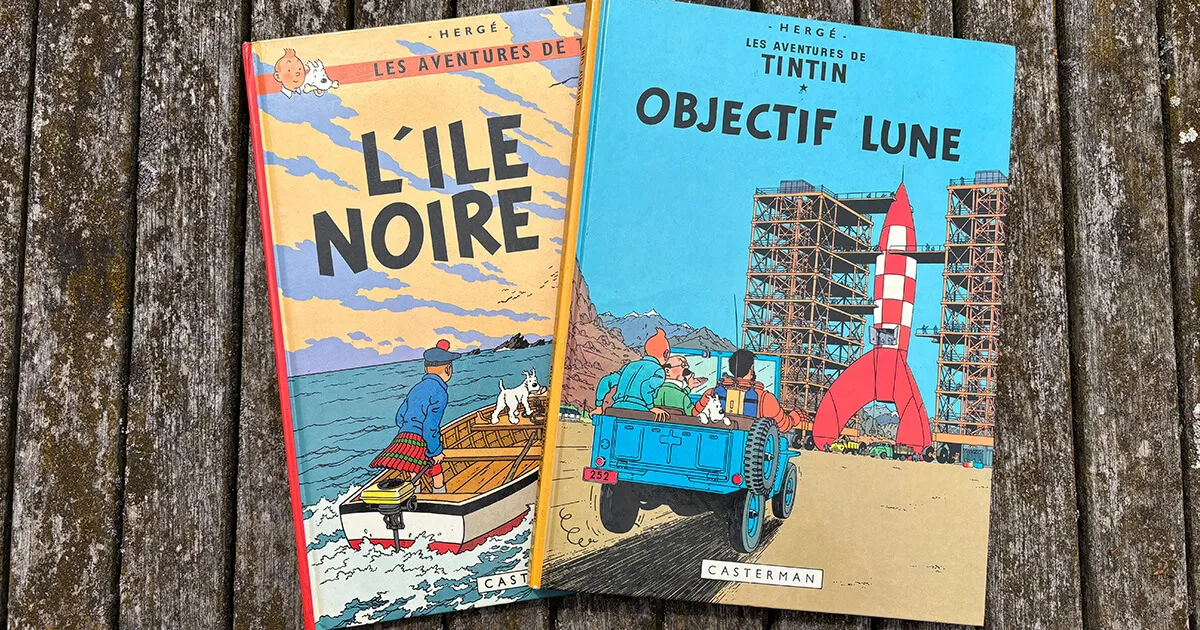
That makes Tintin readable from roughly A2 — genuinely readable, not decode-able. Start with Le Secret de la Licorne or Objectif Lune: tight plots, everyday vocabulary, and the endlessly quotable Captain Haddock, whose insults (« Bachi-bouzouk ! Moule à gaufres ! ») are a lesson in French exclamation all by themselves.
The cultural footnote worth knowing: Tintin is Belgian, and the French-speaking world will remind you of this with pride. The bande dessinée tradition is Franco-Belgian — Brussels has entire walls painted with its heroes.
Stage two: Astérix, the graduation exam
Astérix looks like a children's comic and reads like a doctoral thesis in French wordplay. Nearly every character name is a pun: the dog Idéfix is an idée fixe, the druid Panoramix sees the big picture, the fishmonger Ordralfabétix sells fish in alphabetical order. Romans speak in genuine Latin quotations; every album gently mocks a region of France or a neighboring nation, and the jokes about les Goths, les Bretons or the Corsicans are still how the French laugh about themselves and their neighbors today.
This is why Astérix belongs at B1 and above: the vocabulary isn't hard, but the layers are. Read it too early and you get a story about Gauls punching Romans. Read it at the right moment and you get the funniest French culture course ever written — and the feeling, when a pun lands, of having genuinely arrived in the language.
What these two teach that textbooks don't
Between them, Tintin and Astérix cover a register spectrum no course book touches: Haddock's theatrical outrage, gendarme-formal politeness, market-square banter, and the particular French joy of the jeu de mots. You'll meet exclamations (ça alors !, nom d'une pipe !), the interjection-heavy rhythm of spoken French that no textbook admits exists, and — in Astérix — the cultural shorthand French people use daily without noticing.
When you're ready for the street-level register beyond the classics, the natural next steps are verlan and argot — but that's another article.
How to read them without losing the words
The comic gives every new word a face; your job is to keep it. Read with your phone next to the album: when a word makes you smile — and in Astérix, it will — save it to Vokabulo with its situation, not as a naked translation. The AI wraps it in a natural example sentence, and spaced repetition brings it back right before you'd forget it. Why the picture-plus-context combination works so well is a story of its own.
Thirty pages of Tintin will hand you more usable French conversation than a semester of dialogues about booking hotel rooms. And unlike the hotel dialogues, you'll actually finish.
Reading Tintin this week? Save Haddock's best insults to Vokabulo — with context, they stick. Free to start.