

There is a moment a lot of people know and almost nobody can name.
You ask a question in a meeting. The sentence is correct, the vocabulary is right, the pronunciation passes. And something closes. No frown, no correction, nothing said wrong: just half a second too much silence, and then the conversation carrying on slightly to one side of you.
The reflex at that point is to blame your French. It is the wrong diagnosis. The sentence was fine, and something else happened.
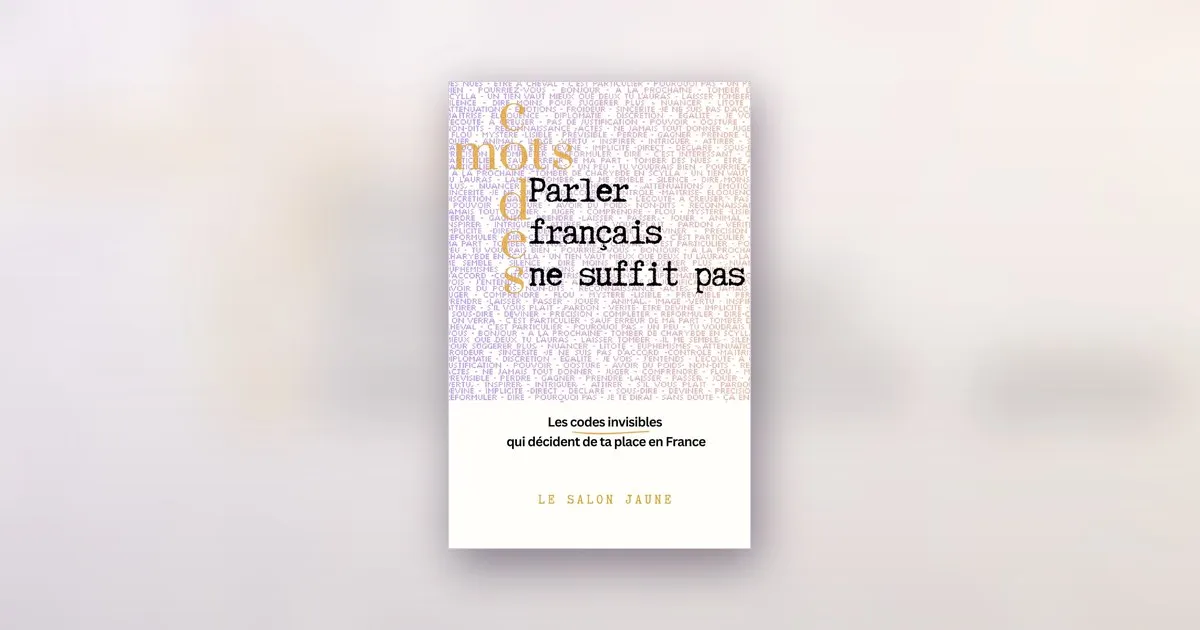
That something else is the entire subject of Parler français ne suffit pas, and it is the first book I have seen explain it properly.
Who wrote it
The book carries the Maison Française name and comes out under the Le Salon Jaune imprint. Behind both names is Lê Thi Mai, a Parisian, an editorial strategy director and a consultant in brand storytelling.
Her training explains a good deal of the book. She did hypokhâgne and khâgne, the two brutally selective humanities years French students spend preparing for the École normale supérieure entrance exam, and then read modern literature at the Sorbonne.
She is not a French teacher, and she is firm about that. « Je ne donne pas de cours de français. La langue est un outil. » I do not give French lessons; the language is a tool. On her site the promise fits in two sentences: « Certains veulent simplement mieux parler. D'autres veulent trouver leur place. »
By her own account, the book started with her own experience of learning languages. For a long time she believed that speaking a language meant mastering its grammar, vocabulary and pronunciation. Learning other languages, she found the hard part was somewhere else. Her words: « Le plus difficile, c'était de comprendre ce que les mots ne disent pas. » The hardest thing was understanding what the words do not say. Why some people come across as cold when they are only being discreet. Why a polite answer can be a refusal. Why a compliment can land as too much.
The book came out of that, and Maison Française came out of the book.
What the book is trying to get across
The thesis fits in two sentences, and both of them are on the back cover: « La conversation française n'est pas seulement un échange. C'est un système social invisible. » French conversation is not only an exchange; it is an invisible social system. The words are just the visible part of it.
From there the book describes what runs underneath:
- the implicit, meaning everything that gets communicated without being stated;
- the invisible hierarchy, which decides who may say what, and in what tone;
- cultural inference, which assumes shared knowledge nobody spells out;
- the French art of qualifying a statement, which is a skill in its own right and not hesitation;
- elegant disagreement, meaning how to object without ever putting yourself in the wrong;
- and the sentences that never quite mean what they say.
The method is concrete: situations, everyday dialogue, a close reading of how people settle their standing in an ordinary conversation. No sociological theory delivered from above, even though sociology is exactly what this is.
The book is equally clear about what it is not, again on the back cover: « Ce livre ne vous apprendra pas le français. Il vous apprendra ce qui se joue réellement derrière les mots. » This book will not teach you French. It will teach you what is really going on behind the words. That is a narrower promise than a coursebook makes, and a far more useful one.
It is written for foreigners living in France, for international professionals, for intercultural couples, and for anyone with the nagging sense that « il y a quelque chose », that there is something going on, without being able to say what.
A word about the obvious risk in a book like this, since she defuses it herself. « Décrire une culture n'est pas demander qu'on l'adopte », she writes: describing a culture is not asking anyone to adopt it, it is making it legible so that everyone can find their place without giving up their own. That is exactly the register of the book. No caricature of the French, and no instruction to become one.
The strapline under the title says it without hedging: « Les codes invisibles qui décident de ta place en France. » The invisible codes that decide your place in France. Note the verb. They do not influence your place. They decide it.
What this changes when you are learning vocabulary
I build a vocabulary app, so I have a bias, and I would rather declare it up front.
Mostly this book confirmed something I have been saying for two years: beginner vocabulary is generic, advanced vocabulary is personal. At the start everyone needs the same two thousand words. After B2 nobody needs the same ones any more, because the words you are missing are the ones from your work, your friends, your meetings.
The book adds a layer I had never put this sharply. Past B2, the problem is often no longer which word but what dose.
Take three ways of disagreeing: « je ne suis pas d'accord », « je ne suis pas sûr d'avoir tout suivi », « c'est intéressant ». I disagree; I am not sure I followed all of that; that is interesting. There is no difference in level between them: all three are sentences an A2 learner understands. The difference is entirely social, it is enormous, and nobody teaches it anywhere.
That is also the honest limit of the book, and the reason it pairs so well with vocabulary work. It gives you the system. It does not give you your own stock of phrases, and it should not have to: that stock is personal, it gets picked up in your own conversations, one expression at a time, at the moment you hear it and finally understand what it meant.
Three pieces on this site take the reading further: the register trap on the line between casual and rude, French filler words, which are the other half of sounding natural, and almost a native speaker on what is left once the grammar is settled.
Verdict
You think you are short of French when you are short of the rules of the game. The book lays those rules out flat, without folklore, and with real affection for the language.
While reading you nod a lot, with the feeling that you are being told things you half knew already. It shows up afterwards: the situations it describes start happening again, except that this time you recognise them while they are happening. That is the best thing you can ask of a book like this, and it is also why I would read it slowly.
The back cover sums it up better than I could: « Comprendre les mots est une chose. Comprendre ce qu'ils veulent vraiment dire en est une autre. » Understanding the words is one thing. Understanding what they actually mean is another.
If you live in France, if you work with France, or if you simply keep getting the feeling that you are missing a piece of information everyone else at the table already has: read it.
Lê Thi Mai, Parler français ne suffit pas. Les codes avant les mots, Le Salon Jaune, 371 pages. ISBN 978-2959613326. Available on Amazon in paperback and on Kindle.
Understanding the codes is half the work, having the words at the right moment is the other half. Vokabulo helps you keep the expressions you actually hear, in full sentences rather than word pairs. Available on iPhone and iPad.