

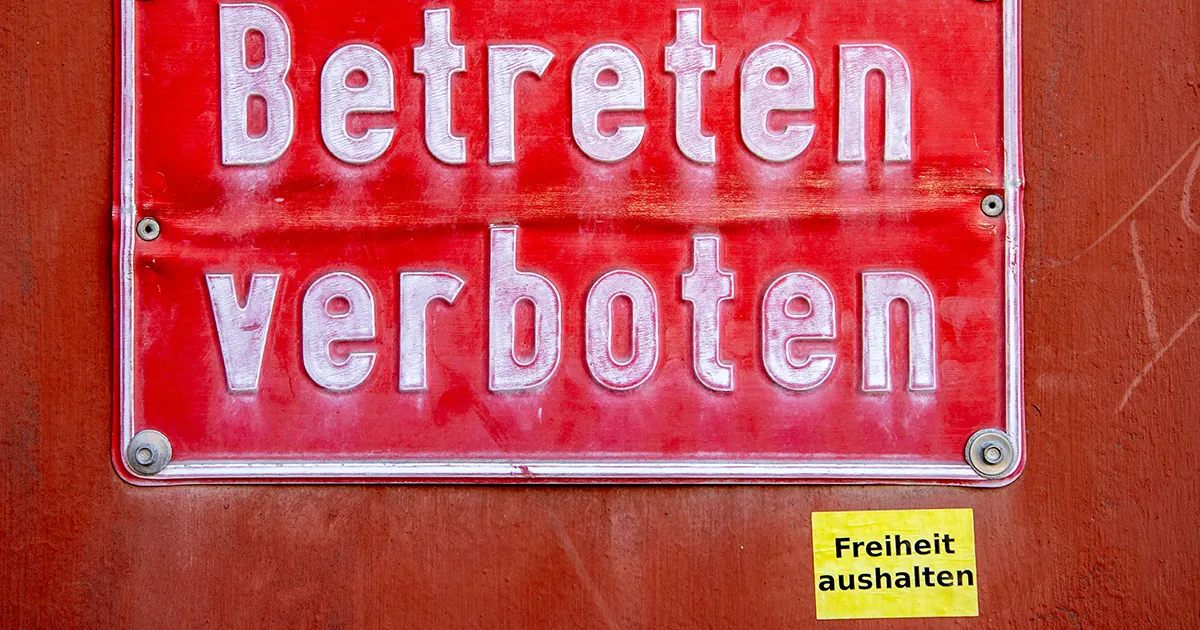
Germans have a reputation for bluntness that is roughly half deserved, and the deserved half is a translation artefact.
German softens with small particles rather than with extra words. English pads a request with clauses: would you mind, if it is not too much trouble, sorry to bother you. German drops a single unstressed syllable into the middle of the sentence and considers the job done. Those syllables do not survive translation, so a perfectly polite German sentence arrives in English stripped of its manners.
Then there are the words that simply sound worse in a learner's ear than they do in a native one. Here are both directions.
Sounds rude, is not
doch: the word English does not have. It contradicts a negative statement, and it is not aggressive. Du magst keinen Käse. Doch! means yes I do, and it is neutral. As a particle inside a sentence it softens rather than sharpens: Komm doch mit is warmer than Komm mit.
mal: the single most useful word in this article. It converts an imperative into a request. Komm mal her is come here a moment, friendly and ordinary. Komm her is an instruction. One syllable carries the entire difference and no dictionary will explain it to you.
Alter: literally the old one, in practice mate or dude. Between friends under about forty it is warm. Said to a stranger it is over-familiar rather than offensive.
geil: the dictionary will tell you it means horny. In actual use, across almost every age group, it means brilliant or fantastic. Das ist ja geil is enthusiasm. The original sense is still live, so it is not office vocabulary, but treating it as obscene will mislead you badly.
Quatsch: nonsense, rubbish. Entirely mild, closer to don't be silly than to anything sharper. Ach Quatsch is often affectionate.
Scheiße: much weaker than its literal translation. It sits about where damn sits in English. Not for a job interview, entirely unremarkable from a colleague who has dropped something.
Das geht nicht: that will not work. A flat refusal with no cushioning, and it is the normal way to say it. No offence is intended and none is usually taken.
Nein.: a complete answer. German does not require the softening apparatus that English does, and a bare nein followed by a reason is a courteous response rather than a curt one.
Sounds fine, is not
Fräulein: it appears in older textbooks and in every film made before 1975. It is obsolete and now reads as patronising. Every adult woman is Frau, regardless of age or marital status.
Herr / Frau: plus a first name, not a warmer version of the formal address. It is a construction with faintly colonial and domestic-service associations, and it lands oddly. Use the surname, or move to first names and du together.
behindert: used to mean lame or rubbish, common in careless speech, and genuinely offensive. It describes disabled people. There are twenty other words for a thing you dislike.
Zigeuner: still printed on the labels of certain sauces and paprika dishes, and still in older dictionaries. It is now avoided. The accepted terms are Sinti und Roma.
And a general caution: German literature and reference books from the middle of the last century contain racial vocabulary that has since become unusable. If you are reading older texts to build vocabulary, and it is an excellent way to do it, do not assume that a word's appearance in print means it is currently safe. When in doubt, ask someone before you use it.
The two that are only awkward
Mahlzeit: heard around offices and canteens from about eleven to two. It is a greeting, not an invitation, and not a question about whether you have eaten. The correct response is Mahlzeit back.
Du / Sie: the real trap is not choosing wrongly but switching without agreement. Wait to be offered du, or offer it explicitly. Wollen wir uns duzen? is a normal thing to say and solves the problem in one sentence.
Why this matters more than grammar
You can be flawlessly correct and still land badly, and you can be grammatically ragged and land perfectly. Register is what people actually respond to.
The good news is that the German half of this is a small closed set. Learn six particles and you have most of the softening apparatus of the language. That is far less work than the case system and it changes how people receive you far more.
This is a different question from how German feedback culture works, where silence is praise, and from the grammar traps that catch every learner. This one is about the words themselves.
How to learn a register
Register is the one thing a word list cannot carry, because register lives in the situation.
Save who said it and to whom. Geil = great is half a fact. Geil, said by my thirty-year-old colleague about a project result, in an open-plan office tells you the whole thing: the word, the register and the boundary. Vokabulo Scenes hold that shape, and a free account includes three.
Give Translate the full sentence. Particles only make sense in context. Mal alone means almost nothing; komm mal her means everything.
Then let repetition install them. Particles are high-frequency and low-salience, which is why learners hear them for years without acquiring them. Deliberate capture plus spaced repetition is what moves them from passive to active.
The short version
Put mal in your imperatives. Do not be alarmed by doch, geil or Quatsch. Never say Fräulein. Wait to be offered du.
And when a German says das geht nicht and moves on, understand that nothing has gone wrong between you. That is simply what the sentence means.
Heard a German word whose register you could not place? Save it in Vokabulo with who said it and where. Free to start on iPhone and iPad. 🇩🇪