
There is a moment every serious learner knows. You are at the till, you followed the whole exchange, you even said something charming back. Then the price arrives and your head goes blank.
For me it was French. I read French contracts, I take calls in French, I watch films without subtitles. And still: the second somebody says quatre-vingt-dix-sept euros quarante at the speed French people actually say it, I am doing arithmetic instead of listening. By the time I finish, the conversation has moved on two sentences.
This is not a knowledge gap. I know French numbers. I could write them out for you, I could explain how they are built. I just cannot hear them fast enough.
Numbers are their own skill, and almost no app treats them that way
Numbers are processed differently in the brain than words, and knowing them is not enough. You have to learn to recognise them by ear.
You do not have to take that as neuroscience to see the point. A word comes with context. Hear baguette in a bakery and you would have guessed it from half the syllables. A number has no context. Soixante and soixante-dix begin identically, and which of the two it was only becomes clear two syllables later. There is nothing to guess at. Either you caught it or you did not.
French is the hard case. Seventy is soixante-dix, sixty-ten. Eighty is quatre-vingts, four twenties. Ninety-seven is quatre-vingt-dix-sept, four twenties plus ten plus seven, and the decisive part arrives last. Add liaison, swallowed final consonants, and the fact that phone numbers are spoken in pairs. Anyone who learned in Belgium or Switzerland, where septante and nonante are normal, starts over again in Paris.
And French does not even hold the record. Danish ninety is halvfems, short for half-fifth times twenty: four and a half twenties, with the half carrying the number. Beside that, quatre-vingt-dix is almost transparent.
So what do the big language apps do with this? They teach the number words in lesson three, on screen, slowly, one at a time. After that the numbers never come back. That is not bad faith, it is a natural consequence of how courses are built: numbers count as beginner material, so they get ticked off at beginner level. That the real difficulty shows up years later, in speed and in the ear, fits into no lesson plan.
What Numfred actually does
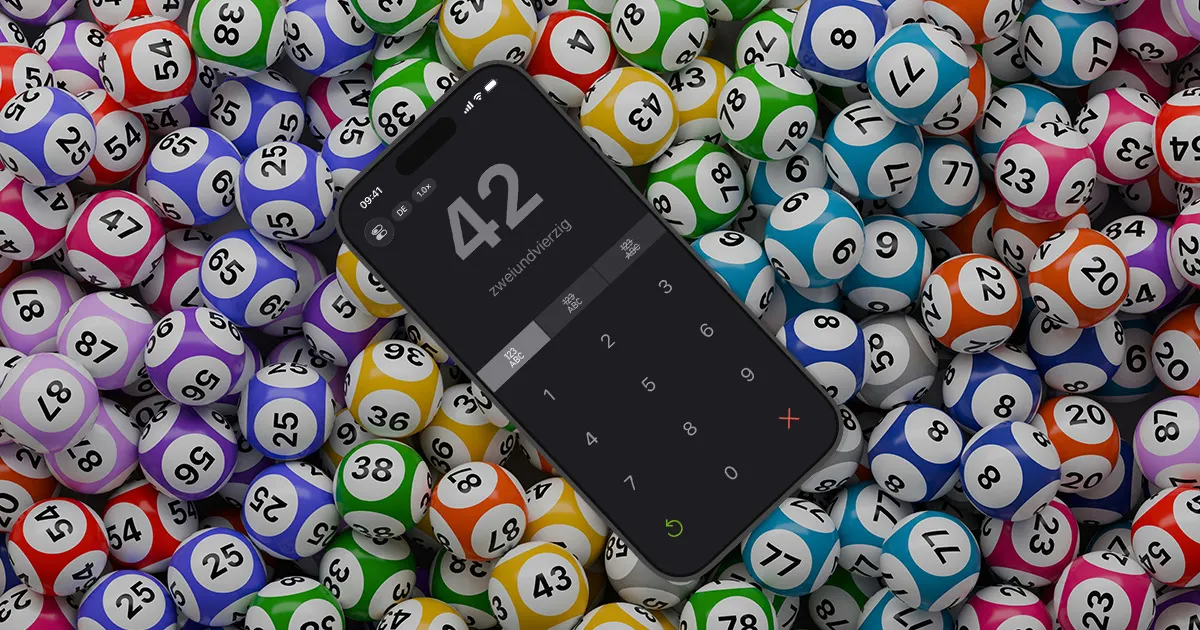
Numfred is an iOS app by Frank Benkelmann, in the App Store since March 2025, and it does exactly one thing: you hear a number, you type it. That is it.
It sounds trivial and that is precisely why it works. There are three levels, and the progression is well judged. On the first, digits and number words stay on screen, so your ear gets training wheels. On the second the digits disappear. On the third you have nothing but the audio. The jump between those levels is exactly the one no course ever makes you take.
Then there are two modes. Listen & Type is hearing and typing, and it is in the free version. Type & Listen reverses the direction, belongs to Premium, and is for people who want to say numbers fluently rather than only understand them. You can restrict the ranges, and that is the most important dial in the app: if prices are what floor you, drill two-digit amounts with decimals, not millions.
The free version covers a few basic ranges up to 29 plus the tens up to 50. Premium goes to 999,999 and adds adjustable voice speed, thousands separators, digit grouping and Family Sharing. Premium is a one-time 9.99 dollars. No subscription, no ads, no account, no tracking, and it works offline.
My own test: French, ten minutes a day
I used Numfred in French, on Premium, in short sessions. Ten minutes, usually over coffee.
Two things stood out.
One: level three is uncomfortable, which is exactly why it pays. As long as the digits are on screen you feel good and learn little. The moment they go, you find out precisely where your ear falls off. For me that was reliably the range between 70 and 99, which is exactly where French is structurally awkward.
Two: the speed control is the real trainer. Understanding numbers at a gentle pace is within reach of anyone at B1. Daily life does not speak at a gentle pace. I pushed the speed up step by step, and the interesting part came afterwards: platform announcements and prices at the till suddenly felt slow. Not because the world had slowed down, but because I had been practising in a faster one.
This is not an app that changes your French. It is an app that clears one narrow, well-defined weakness, and it does that surprisingly fast, precisely because the weakness is small and mechanical.
Why it sits so well next to a vocabulary app
With Vokabulo I am building an app for people who already speak a language and still sound simpler than they are. The road there runs through vocabulary: through precision, through naturalness, through range. Numbers do not belong on that road, because they are not a vocabulary problem. A number word has no nuance and no tone. It only has speed.
Numfred trains the one mechanical skill no vocabulary app can sensibly cover. The vocabulary app handles everything that carries meaning. Run both and you close a gap most learners do not know they have, because they file it under nerves.
The honest test is this one: have somebody say a French number between 70 and 99 at normal speed, with no warning. If you have to calculate, that is not a proficiency problem. It is a training problem, and it is one of the few that genuinely resolve in a few weeks.
How French numbers actually sound
The real opponent is not the arithmetic, it is the pronunciation: the same number sounds different depending on what comes after it. Six on its own ends in a hissed s. Before a consonant that s vanishes, so six personnes arrives as “si personnes”. Before a vowel it turns into a z, so six euros runs together as “sizeuros”. Dix behaves identically, huit loses its t before a consonant, cinq loses its final k, and neuf becomes neuve in neuf heures.
Then there is the t of vingt: silent on its own, audible from vingt-deux to vingt-neuf. And because a French number runs straight into the word after it, there is no pause between the number and the thing it counts for your ear to hold on to.
The phone number is the hardest case of all, because both difficulties arrive at once. You do not hear 06 12 34 56 78 as ten separate digits, you hear zéro six, douze, trente-quatre, cinquante-six, soixante-dix-huit. Five numbers said, ten digits to write down, and waiting at the very end is soixante-dix-huit, one of the constructions that takes longest to resolve in your head. Practise that once on purpose and phoning in French loses a surprising amount of its terror.
Verdict
In its full version Numfred costs less than a single month of most language subscriptions, and in return it does one thing and does it properly. I recommend it without reservation to anyone who understands everything in their second language except the numbers. The app is beautifully made, too. You can tell someone with a design background was at work here.
You will find it at numfred.com and in the App Store.