

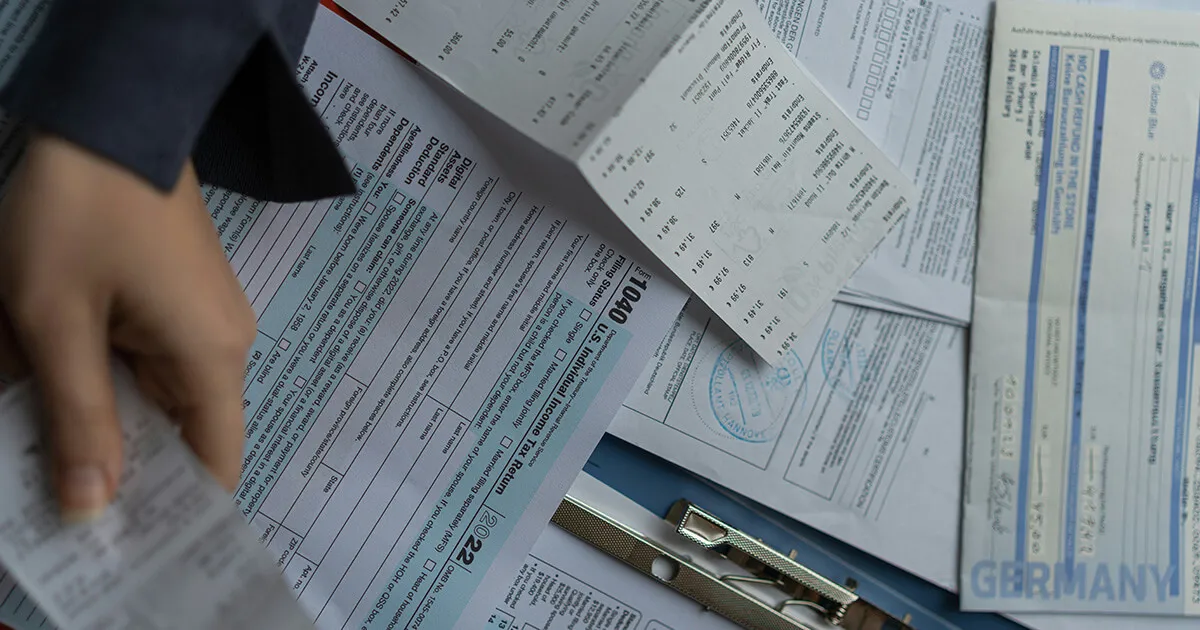
Here is a piece of information that surprises a lot of newcomers to Germany: for most employed expats, filing the Steuererklärung (annual tax return) results in money coming back to you, not going out.
Germany withholds income tax at source through the Lohnsteuer system — your employer deducts it from your salary every month based on your tax class. But the withholding is often a rough estimate. If you worked for only part of the year, had work-related expenses, paid professional education costs, or have a partner whose income is different from yours, a tax return typically produces a refund.
The average refund for German taxpayers is over €1,000 per year. The vocabulary below is the key to claiming yours.
The Basics
Steuererklärung: the annual tax return. Not mandatory for most employed workers on a standard tax class, but almost always financially advantageous. If you are self-employed, have multiple income sources, or receive certain types of income above a threshold, it is mandatory.
Finanzamt: the tax office. Germany has local tax offices by district (Wohnsitzfinanzamt); your relevant office is determined by your registered address. All correspondence goes through your local Finanzamt.
Steueridentifikationsnummer (Steuer-ID): your personal tax identification number. Issued automatically after your address registration (Anmeldung) and sent by post. Permanent — it doesn't change if you move. Required for employment, tax filing, and banking.
Steuernummer: the tax number assigned by your Finanzamt, specific to your district. Different from your Steuer-ID; used on correspondence with your local tax office.
Veranlagungszeitraum: the assessment period. The German tax year is the calendar year (January 1 to December 31).
Abgabefrist: the submission deadline. If you file yourself without a tax adviser (Steuerberater), the deadline is July 31st of the following year (for the previous year's return). If you use a Steuerberater or Lohnsteuerhilfeverein, you have until the end of February the year after that.
Income and Tax
Einkommen: income.
Lohn / Gehalt: wages / salary. Lohn is typically hourly; Gehalt is monthly salary. The distinction matters in some form fields.
Lohnsteuer: the wage tax withheld from your salary each month by your employer. The foundation of the German income tax system for employees.
Lohnsteuerkarte / Steuerklasse: the tax class (Steuerklasse) determines how much Lohnsteuer is withheld. Classes range from I (single, no children) to VI (second job). Class I and IV are the most common for expats. Wrong tax class = wrong withholding = a larger-than-necessary monthly deduction that you claim back via the Steuererklärung.
Lohnsteuerbescheinigung: the annual wage tax certificate. Issued by your employer in January for the previous year. This is the core input document for your tax return; it shows how much you earned and how much tax was withheld.
Solidaritätszuschlag (Soli): the solidarity surcharge, a supplementary tax added on top of income tax. Phased out for most taxpayers since 2021, but still visible on payslips.
Kirchensteuer: church tax, deducted if you declared a religious denomination on your Anmeldung form. Deductible in the tax return.
Deductions
Werbungskosten: work-related expenses. Deductible items that relate to your employment: commuting costs, professional equipment, work clothing, professional development courses, union fees, professional literature. Germany automatically grants a standard deduction (Arbeitnehmer-Pauschbetrag) of €1,230 per year; anything above this amount can be claimed with receipts.
Pendlerpauschale: the commuting allowance. For every kilometre between your home and workplace, you can deduct a set amount per working day (currently €0.30 for the first 20km, €0.38 beyond that). If you commute by car or public transport, this is one of the most commonly claimed deductions.
Sonderausgaben: special expenses. A separate category including pension contributions, health and long-term care insurance premiums, charitable donations, and childcare costs.
Haushaltsnahe Dienstleistungen: household-related services. Cleaning, gardening, and maintenance services can be partially deducted — provided they are invoiced and paid by bank transfer (cash payments do not qualify).
Handwerkerleistungen: tradespeople's services. Work done by a plumber, electrician, painter, and so on at your primary residence can be partially deducted.
Umzugskosten: moving costs. If you moved for professional reasons (new job, employer relocation), moving expenses may be deductible.
Filing
ELSTER: the official online portal for German tax returns (elster.de). Free to use; requires registration and a certificate. Used by millions of Germans for self-filing.
Anlage: appendix. Tax returns are modular; you add the appropriate Anlagen (appendices) for your situation:
- Anlage N — employed income
- Anlage KAP — capital income (savings interest, dividends)
- Anlage V — rental income
- Anlage R — pension income
- Anlage AUS — foreign income
Steuerberater: a tax adviser. Professional help is particularly valuable if you have complex international income, self-employment, or if this is your first German tax return. Fees are tax-deductible.
Lohnsteuerhilfeverein: a membership-based tax assistance organisation. Much cheaper than a Steuerberater, open to employed workers with no complex additional income. Membership typically costs €50–€200 per year.
Steuerbescheid: the tax assessment notice. The document from the Finanzamt stating the result of your return: how much you owe, or — more commonly for expats filing for the first time — how much you're owed back.
Erstattung: refund. The amount the Finanzamt owes you.
Nachzahlung: an additional payment you owe.
Einspruch: an objection/appeal. If you disagree with your Steuerbescheid, you have one month to file an Einspruch in writing.
One Reason Not to Skip It
The most common reason expats don't file a Steuererklärung is that they assume it's complicated and they probably don't have to. Both assumptions are often wrong. The vocabulary for navigating German official life rewards the effort; so does the average refund. ELSTER in English mode and the range of affordable advisory services make it accessible even in year one.
Building the specific vocabulary for your professional and administrative life abroad is an investment that pays back materially — not just linguistically.
Tax season in German requires vocabulary, not just patience. Vokabulo helps you prepare for the documents and conversations that come with filing abroad. Available on iPhone and iPad.