

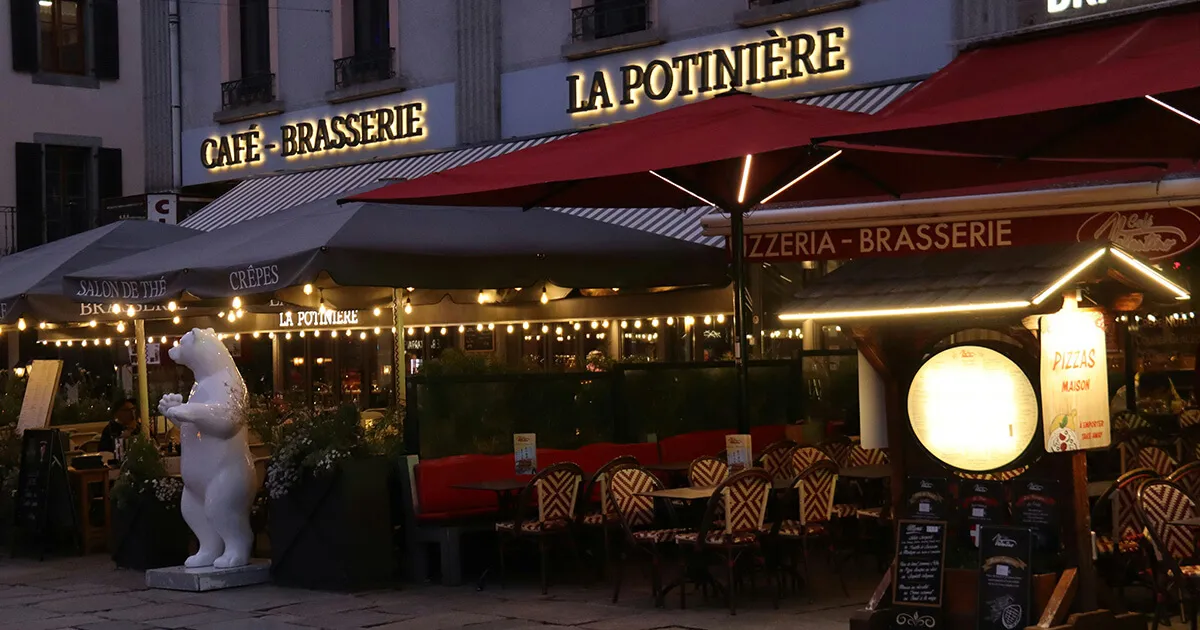
Eating out in France is one of the great pleasures of expat life — and one of the places where limited language most visibly limits your experience. Not because French restaurant staff are unwilling to help (they usually aren't), but because French dining has a specific vocabulary, a specific rhythm, and a set of conventions that, once understood, make the whole experience significantly better.
Here is what you need for the full arc of a French restaurant meal.
Types of Establishments
Restaurant: a restaurant (full menu, table service, lunch and dinner).
Brasserie: a larger, more casual restaurant with a broader menu available throughout the day. Often also serves beer (bière) prominently.
Bistrot / Bistro: a smaller, informal neighbourhood restaurant. Often simpler menu, chalk specials board, relaxed atmosphere.
Café: primarily a drinks venue, but almost always serves simple food (sandwiches, croque-monsieur, quiche).
Brasserie de quartier: a local neighbourhood brasserie, combining café, bar, and restaurant functions.
Crêperie: a restaurant specialising in crêpes and galettes (buckwheat crêpes, savoury, typical of Brittany).
Auberge: an inn/restaurant, typically in a rural or village setting.
Gastronomique: fine dining / gastronomic restaurant.
Étoilé: Michelin-starred.
Reading the Menu
Menu: the fixed-price menu (confusingly, the word menu in French refers to a set meal with multiple courses at a fixed price, not the à la carte list of dishes). The carte is what English speakers call "the menu."
Carte: the à la carte menu.
Formule: a slightly less formal version of the menu; a set option, often at lunch: e.g., plat + dessert or entrée + plat.
Le menu du jour: today's set menu.
Plat du jour: dish of the day.
Entrée: starter. Important: in French, entrée means starter, not main course (as it does in American English).
Plat (principal): main course.
Dessert: dessert.
Fromage: cheese (often served as a separate course between plat and dessert, or instead of dessert).
Amuse-bouche: a small single-bite appetiser served before the starter, compliments of the kitchen.
Hors-d'œuvre: starter / appetiser (more formal than entrée in some contexts).
Ardoise: the specials board (literally: a slate/chalkboard).
À la carte: ordering individual dishes separately rather than from a menu.
Common menu descriptions:
- Maison — made in-house, by the restaurant
- Du terroir — locally sourced, regional
- Cru — raw
- Cuit — cooked
- Grillé — grilled
- Rôti — roasted
- Poêlé — pan-fried
- Braisé — braised
- Fumé — smoked
- Confit — slow-cooked and preserved in fat
Ordering
"Nous avons une réservation au nom de [Nom]." — We have a reservation in the name of [Name].
"Nous sommes [nombre] personnes." — We are [number] people.
"Nous n'avons pas encore choisi." — We haven't chosen yet.
"Je prends le menu à [prix]." — I'll take the set menu at [price].
"Pour moi, ce sera le [plat]." — For me, it will be the [dish].
"Qu'est-ce que vous nous recommandez?" — What do you recommend?
"C'est quoi exactement, le [plat]?" — What exactly is the [dish]?
"Je suis allergique à [aliment]." — I am allergic to [food].
"Je ne mange pas de viande." — I don't eat meat.
"C'est sans gluten?" — Is it gluten-free?
"Bien cuit / à point / saignant" — well done / medium / rare (for meat, especially steak).
"Rosé" — medium-rare (between saignant and à point).
Wine
"Quelle est votre suggestion pour accompagner ce plat?" — What's your suggestion to accompany this dish?
"Une carafe d'eau, s'il vous plaît." — A jug of water, please. (Tap water is free in French restaurants and you are fully entitled to request it.)
Carte des vins: wine list.
Verre de vin: a glass of wine.
Demi-bouteille: a half-bottle.
Vin du pays / vin de table: house wine.
Pétillant / Gazeux: sparkling.
Plat / Non gazeux: still.
During and After the Meal
"C'est très bon." — It's very good.
"C'est excellent." — It's excellent.
"Je peux avoir un peu plus de pain?" — Could I have a little more bread?
"L'addition, s'il vous plaît." — The bill, please.
"On peut payer séparément?" — Can we pay separately?
"Est-ce que le service est compris?" — Is service included? (In France, service compris (SC) — a 15% service charge — is included in all restaurant bills by law. You are not expected to tip additionally, though rounding up is common for good service.)
"Vous acceptez la carte?" — Do you accept card?
"Je vous fais un doggy bag?" — Can I have a doggy bag? (Now fairly accepted in France following a 2016 law; less cultural resistance than previously, though not universal.)
Dining out in French is one of the most rewarding uses of the language you're building — and one of the most visible to the people around you. The vocabulary above is what makes you a diner, rather than a tourist at a table.
French dining vocabulary is practical vocabulary that improves your life immediately. Vokabulo helps you build exactly the words for the table you're at. Available on iPhone and iPad.