
Your textbook taught you Guten Tag.
Guten Tag is grammatically perfect, universally understood, and used by roughly nobody in ordinary life outside a formal office or a doctor's waiting room. Say it to a colleague at eleven in the morning and you will get a slightly puzzled look, in the way an English speaker would look at someone who said good day, sir at the coffee machine.
Germany, Austria and Switzerland run on regional greetings, and each one carries a small badge of information about where you are and who you are pretending to be. Here is the map.
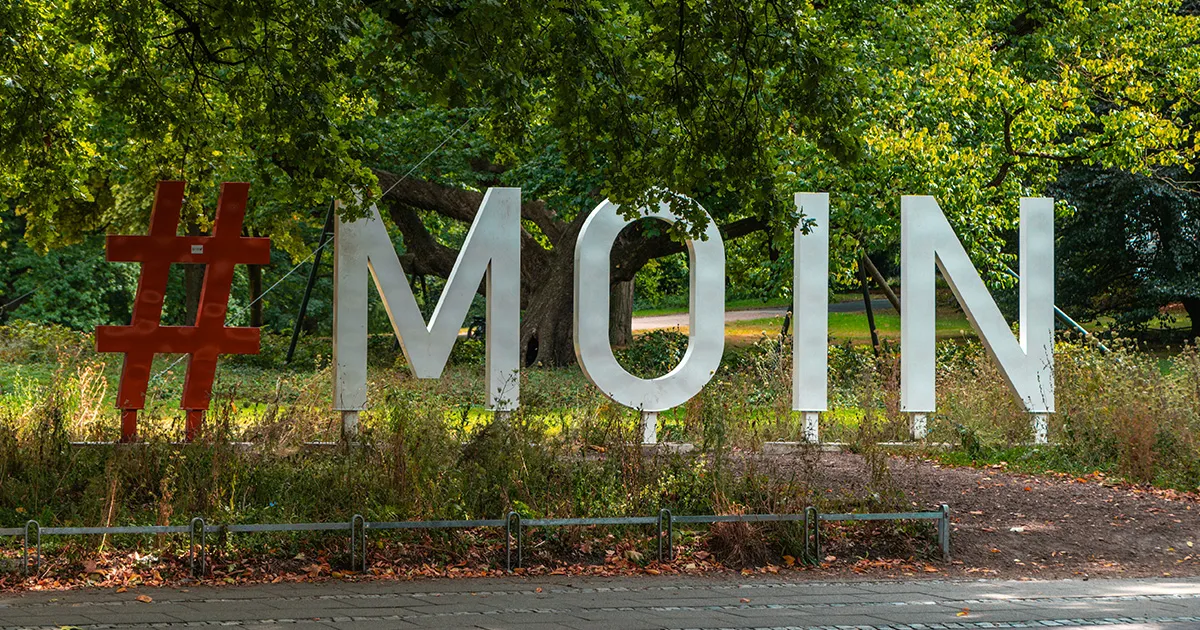
The north: Moin
Moin: hello, at any hour of the day or night. Not a contraction of Morgen. It comes from the Low German moi, meaning good or pleasant, which is why using it at three in the morning is entirely correct.
Moin Moin: the same, doubled. Northerners will tell you, only half joking, that saying it twice is already excessive chatter.
Moinsen: the younger, more casual variant. Common in Hamburg and along the coast.
Moin has been quietly conquering the rest of the country for twenty years and now turns up in Berlin and the Ruhr. It is still unmistakably northern.
The Rhineland and the Ruhr
Tach: a flattened Tag. The everyday greeting from Cologne through Düsseldorf and into the Ruhr, and one of the friendliest sounds in German.
Jou: an all-purpose Ruhr particle that does yes, hello, and I acknowledge you, depending on the eyebrow.
Hessen
Gude: the Hessian greeting, used from Frankfurt am Main outwards. Morning, noon or night, to a stranger or your neighbour. Short, flat and unimpressed, which is very much the local register.
Berlin
Na?: a complete greeting, a complete question and a complete sentence, all in two letters. It means roughly so, how are things, and the correct reply is Na.
If you can hold a short exchange consisting only of na, you have understood something important about Berlin.
The south: Bavaria and Austria
Servus: hello and goodbye, from the Latin servus, servant, as in at your service. Informal, warm, and used in both directions, which makes it the most useful word in southern German.
Grüß Gott: literally greet God, in practice simply hello. Standard across Bavaria and Austria, entirely secular in daily use, and normal with strangers and shopkeepers.
Habedere: Austrian, contracted from habe die Ehre, I have the honour. Old-fashioned, slightly theatrical, and still very much in circulation.
Pfiat di: goodbye, from behüte dich Gott. The southern farewell you will not find in a course.
Baba: the light Austrian goodbye. Often baba und foi net, bye and don't fall over.
Switzerland
Grüezi: the Swiss German greeting, to one person. From Gott grüez i, may God greet you.
Grüezi mitenand: the same, to a group. Getting this distinction right is a small but real signal.
Hoi: the informal version, for friends, and hoi zäme to a group of them.
Adieu / Ade: goodbye in the west and the Swabian southwest, borrowed straight from French and pronounced flat.
The goodbyes, briefly
Tschüss: originally northern, now national. Thought to have travelled from the French adieu through adjüs into Low German before spreading.
Auf Wiederschauen: the southern counterpart to auf Wiedersehen, because in the south you look rather than see.
Ciao: everywhere, and unremarkable. German has absorbed it completely.
What the choice actually signals
This is the part nobody tells you. A greeting in German is a claim about belonging, and getting it wrong is harmless but audible.
Grüß Gott in Hamburg sounds like you learned German in Munich, or from a book. Moin to a Bavarian official is chummy in a setting that is not. Hallo is the honest neutral: it works everywhere, with everyone, and never claims a region you are not from.
The good news is that Germans are delighted rather than offended when a foreigner uses the local form. Say Gude in Frankfurt am Main and you will get a real reaction, because you have signalled that you noticed where you are. That single word does more social work than a paragraph of correct grammar.
How to actually learn these
The problem with regional greetings is that they are situational, and situational vocabulary does not survive being learned from a list.
Save them with the place attached. Servus = hallo is a dead fact. Servus, said by the man behind the counter at the bakery in Munich, both when I came in and when I left is a memory. That is what Scenes are for in Vokabulo, and a free account includes three of them.
Use Translate on the whole exchange. When someone greets you with something you have never heard, type the entire line rather than the word you think you caught. Na, alles klar? makes sense as a unit and not much sense in pieces.
Then let repetition do the rest. Greetings come at you constantly, so they climb the levels quickly. Within a fortnight the right one will arrive before you have consciously chosen it, which is the whole point.
The short version
Guten Tag is a safe answer to a question nobody asked. The country is full of better ones, each attached to a place, and picking up the local one is the cheapest way to stop sounding like a visitor.
Start with Hallo when you are unsure. Then listen to what the person in front of you says, and say that back.
For a broader look at what changes when you cross a regional border, see navigating German dialects.
Heard a greeting you could not place? Drop it into Vokabulo with the place you heard it and keep the whole map. Free to start on iPhone and iPad. 👋